Merlin (1998)
This is the story that inspired generations of fantasy authors. This epic tale, wrapped in myth and exhausted by legend, has some of the most notorious characters ever remembered. King Arthur and Morgan la Fay. Galahad, Lancelot, Mordred, Guinevere, Merlin. We have heard their names since childhood, read their stories in books of fairy tales, heard whispers of them through epic productions. But never before has it been told through the eyes of Merlin.
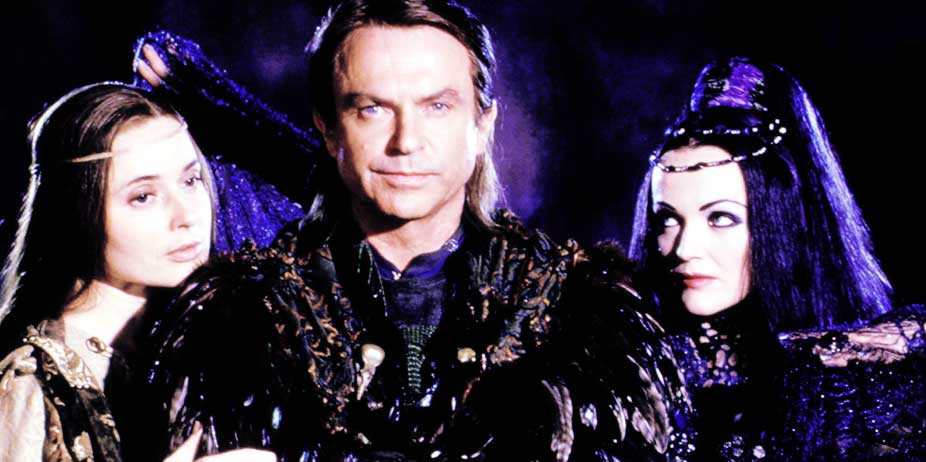
England lies in a bloodbath at the hands of tyrannical leaders. Christianity has arisen a new generation of believers, and the mythical creatures of the "old way" of life fear for their immortal souls. Queen Mab (Miranda Richardson) is the most powerful of these pagan forces. Desiring to bring into being a child, half-human half-magic that can help restore order among the divided people, she creates Merlin. In his happy childhood, he is raised by an old woman of the Christian order, who cautions him against the evil Queen Mab. When Merlin has reached adulthood, Mab takes him under her wing. But Merlin clings too much to his Christian upbringing, and has no interest in learning magic. The kingdom is under the command of a ruthless king (Rutger Hayer), who holds hostage Lady Nimue (Isabella Rossellini) to prevent her father from forming an alliance with invading forces. Queen Mab knows to place Nimue in danger will force Merlin (Sam Neil) to use his powers in order to save her, and promises King Vortigern victory in battle if he sacrifices his hostage to the dragons. Rescuing his beloved but too late to prevent her from being physically scarred, Merlin swears allegiance to the invading king in order to harm Mab.
When it becomes apparent that no ruler has the strength and goodness to bring peace to the realm, Merlin makes a decree that only one pure enough to pull Excalibur from the stone shall rule unhampered. Violence and instability follows, Merlin caught in the midst of it as Mab enlists the vicious Morgan Le Fay (Helena Bonham-Carter) to bring down the monarchy of Camelot. Blending myth with imagination, Hallmark brings to life one of the most glorious visual productions of recent years. Everything about it is impressive, from the amazing cast to the magnificent special effects. While it is true that some of their animated griffins and creatures of the wood appear a bit stiff, their fairies, spells, and fantastic woodland transformations are astounding. The production is extremely lush and approached from a unique, eccentric perspective that lends an ethereal charm to the surroundings.
Everything about it appears magical and at times you want to step through the screen into the glory of Camelot. Queen Mab is particularly effective, from her pagan-Goth appearance to the harsh whisper of her tone, a direct contrast from the filmy, ghostly Lady of the Lake, and her necklace of shimmering minnows. I watched this film a number of years ago and was rather shocked by its melodramatic and overly dark twist on the legends of my childhood. As an adult, I can now see the beauty of its depth and perceptions. The one thing I am still not wholly content with is the presence of paganism and Christianity in the same epic tale. Queen Mab and her evil tricks really are the center point of a film that uses Christianity only as provocation to spur a fantastic set of events. The interesting thing about the film is its underlining messages: both leading ladies are corrupted through a desire to remain beautiful. But as Merlin wisely tells both, "Beauty is but an illusion. It does not last forever." Bravo... it's the best line in the whole movie.
Since Merlin is half-human he shows many human weaknesses. He makes mistakes and wrong judgments. Many of the characters in the story suffer the dire consequences. Sinful behavior is presented but not glorified; in fact, the dark things that unfold as a result often bear grim tidings of retribution. Morgan seduces Arthur, who does not realize she is his half sister. The child resulting from that union threatens the balance of Camelot. Lancelot and Guinevere conduct an affair in Arthur's absence, leading to the death of Lancelot's wife and division among the knights. Most of these actions are implied but a couple of them are shown. The Lady of Shallot sees her husband kissing Guinevere on a bed in her mirror. Morgan and Arthur are shown in an intimate setting, and Merlin finds out about their union through wax depicting lovers entwined. Merlin casts a spell over the king so he can bed a beautiful maiden under the guise of being her husband.
There is a good deal of battle violence and numerous war scenes, with the usual carnage but little bloodletting. A battlefield turns crimson with the fallen. Swords are pushed through chests, and wizards weep over the dead. Nimue strikes a selfish bargain with Mab to keep Merlin away from Arthur; her price is her freedom; the benefit, a life with Merlin and her beauty restored. Merlin makes the right choice in returning to Camelot, but in the end the two are reunited. It paints a mixed message that "the end justifies the means." Although the phrase is repeated several times, even by Merlin himself, one wonders at the end of the film if the journey itself is not more important than the conclusion. The production has many delightful moments. Several scenes with Mordred and "Auntie Mab" are especially memorable, Flik's romance with Morgan has a surprising element of selfless love to it, and the production has a happy ending. But for many families, the mixed messages of magic and the problematic content will keep Merlin lost in legend.