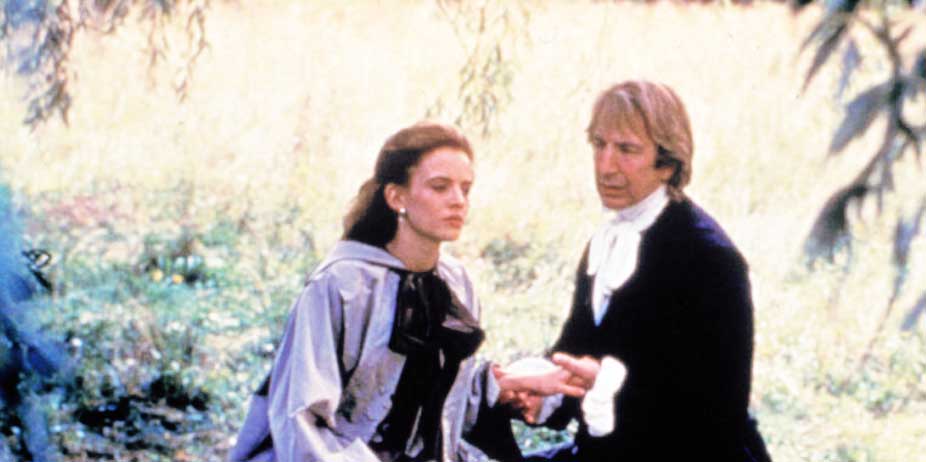
 Mesmer
(1994)
Mesmer
(1994)
Have you ever wondered where the term “mesmerized” comes from? Its original meaning is derived from the name of Fraz Anton Mesmer, an 18th century physician, hypnotist, and self-promoter able to “mesmerize” his patients through animal magnetism. Often the doctors of the time chose bleeding as the cure for everything from fevers to epileptic fits. Mesmer (Alan Rickman) loathed the practice and introduced his own means of medicine. He believed the body could be brought into harmony with nature by removing the bad aura and replacing it with the good.
After curing his cousin Francesca (Anna Thalbach) of epileptic fits through this practice, Mesmer is introduced to his next patient at a music recital. The traumatized blind pianist (Amanda Ooms) suffers a mental breakdown after loosing her place in the piece. Her doctors can think of no other remedy but bleeding, to which Mesmer heartily protests. He insists on being allowed to calm the girl without medical assistance but the use of his hands and voice. At first his gentle intervention has no influence over the flailing and screaming aristocrat, but eventually she becomes subdued and “mesmerized” by his presence. Maria’s doctors forbid her from seeing him again as a patient, but the girl is determined to know more. His comforting voice and gentle hands have offered her the reassurance no man has. All her life doctors have inflicted pain in an attempt to heal, and the men in the household have used her abominably. Through means of blackmail, she is allowed to spend an hour each day with Mesmer, who is convinced her sight is an emotional loss rather than a physical one. As he works to restore her eyesight, he finds his growing obsession to cure her to be all-consuming. He has failed in many respects with other patients; able to relieve their symptoms for a time, inevitably the illness returns.
To complicate the situation, his scheming, disdainful wife has growing concerns her husband may be having an affair with his beautiful patient, and conspires to evict him from the house. Challenged by all traditional means of medicine, kept at odds with a mercenary older wife, and daunted by past failures, Mesmer must come to grips with the fact he is human and complete harmony is not within his power. The film both takes seriously new age therapeutic methods and rebuffs them. The story is not in essence about Mesmer’s way of healing, but rather the man himself. Mesmer is an enthralling psychological study of man’s desire to have control over the incontrollable. The force that drives him is his desire to ‘crawl above the dirt of the world’ and reach perfect harmony. As Christians, we know our fate is held in the hands which sculpted the universe. It's infinitely sad to watch Mesmer search for a “miracle cure,” when we know none exists. Only God controls the fate of His children; not mankind.
We shudder at some of Mesmer's self-promotion yet feel sorry for him when humiliated. We smirk as he leads an entire roomful of aristocrats into foolish shenanigans purely to make a show of them. His ironic sense of humor and piety makes for an interesting blend. The one trait which makes him likable is that he seeks to protect the women around him. There is a true purity in his relationship with Maria, and his afflicted cousin’s admiration for him is touching. It is to Mesmer that she goes for comfort and security, knowing he alone will never take advantage of her. Although the film is not rated, it would have received a PG13 release due to some of the themes addressed. The content itself doesn’t warrant more than a PG but the topics handled are adult in nature. Maria’s father has been sexually abusing her since childhood. The director chose in good taste to refrain from showing us any activity, but we are witness to a revolting scene in which the father gropes her. Mesmer’s stepson attempts to take advantage of his cousin Francesca by forcing her onto the bed.
It could also be argued there is an erotic element in Mesmer’s tactics. Many will find his magnetic touch inappropriate, as it consists of laying the hands on the girl’s neck and drawing them down across her breasts to her waist. He uses it only in the most extreme circumstances. Some of the ‘healing’ ceremonies result in pandemonium as women faint and scream. A crowd turns rabid at one point and turn on the doctor. There is some violence (mainly people being thrown to the ground, and two girls having epileptic fits) and one instance of bleeding for medical purposes. By in large the best thing about Mesmer is the performance by Alan Rickman. His languid, deep tones offer a soothing comfort to his patients while his features are able to transform in an in instant from compassion to fury. The look which often comes over his face is incredibly profound; a literal wiping away of the pain to produce a confident smile. Overall the movie has a lot of flaws, and is far too dark and sexually oriented for many. But Alan Rickman, as always, is mesmerizing.