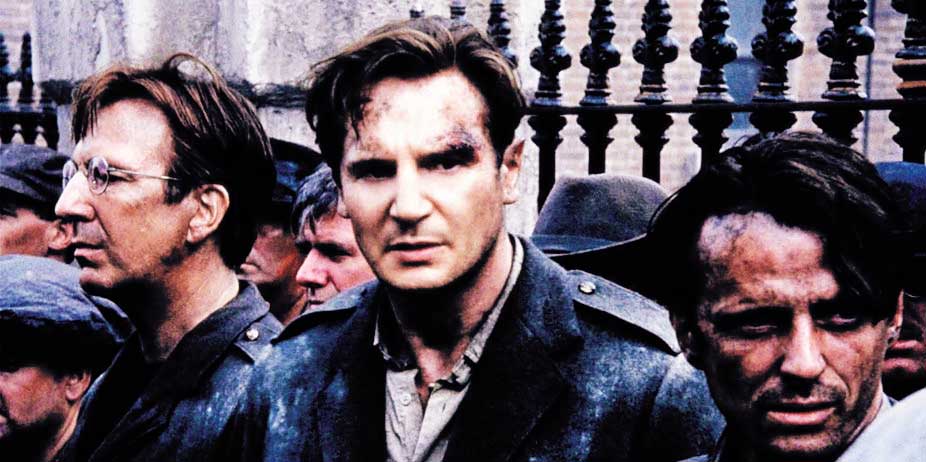
 Michael
Collins (1996)
Michael
Collins (1996)
Throughout history there have been a succession of remarkable men that carved a niche out for themselves in the realm of the legendary. One such individual is Irish Republican Michael Collins, whose controversial life and death inspired director Neil Jordan to write and produce a biopic based on his story.
After spending several years imprisoned along with fellow revolutionists in the ongoing battle against the British occupation, Michael Collins (Liam Neeson) is released back onto the streets of his beloved country. Rather than remaining silent, he raises an outcry among the people that will not be silenced. Together with close friend Harry Boland (Aidan Quinn), he seeks to reestablish the Army of the Irish Republic. Involved in covert operations against the occupiers, Collins manages to win over and recruit a member of the opposing party through his stirring speeches. Given information that warns him the leaders of the group, including their appointed "president" Eamon de Valera (Alan Rickman), are soon to be arrested, Collins passes along the knowledge to his superiors, who believe their arrest will only fuel the public's indignation.
Rather than follow in the wake of his fellow party leaders and allow himself to be captured, Collins becomes the new leader of an army formed to strike at the very heart of the English. Warning anyone who crosses them that their lives will be forfeit, his men carry out a succession of brutal assassinations against known traitors and supporters of the British. Winston Churchill raises an elite task force against them in retaliation, but their plans to release de Valera from prison are successful. The two men butt heads over a course of action, de Valera in favor of diplomacy rather than brutal warfare. He desires to recruit the Americans in favor of their cause and plans a journey to Washington to speak with the president, insisting that Harry accompany him. This is in the hope that Collins will be less influential without him, but inadvertently throws Collins into the presence of Harry's beautiful friend Kitty (Julia Roberts).
Through the hell of war into the dangers of politics, Michael Collins raises a paradox of emotions in its viewers, who are torn between their admiration for his fortitude and their distaste for the means through which he demands power. The IRA was instigated with a good cause behind it, that of liberating the Irish from English command, but very shortly became a terrorist organization that to this day maintains blood in the streets. Without traversing into the politics of the piece, the film is very well done, albeit about twenty minutes too long and with numerous faults. The production itself is remarkable for its clarity and the cinematography is just breathtaking. Neeson and Rickman shine, but one of the more interesting performances is actually by Ian Hart, as Collins' support and consultant throughout each engagement. The writing could have been polished a little more, since non-history buffs will be a little confused as to the inner workings of Irish politics, but overall it's a very thought-provoking film.
No sexual content intrudes, but the rating is well-deserved due to excessive profanity (at least thirty uses of the f-word, twenty abuses of Christ's name, and other mild profanities and European slang) and occasionally brutal violence. Men are mowed down in gunfire, some graphically shot execution-style (one bullet to the head becomes gory). Explosions rock buildings and accumulate in high body counts. Men are hunted down and assassinated, with gruesome results. There's a fair amount of blood. A man is beaten mercilessly and then strung up from the rafters so that he will suffocate, in an attempt to obtain information. The most disturbing scene in the film is when a tank rolls calmly into the midst of a football game, then opens fire on the occupants, murdering men, women, and children in cold blood as punishment for the Irish supporting the IRA. Depending on your view of the title character, he is either an honorable man forced into violent actions through patriotic ardor for his country, or a terrorist responsible for encouraging an organization known for its brutality. For history buffs, it's a fascinating glimpse into the past, but the language is unpardonable.