Moby Dick (2011)
I have never tried to read this epic tome, considered by many to be the classic American novels -- and the bane of college students everywhere. But the themes of man vs. nature, and man vs. God, come through magnificently in this surprisingly stirring miniseries.
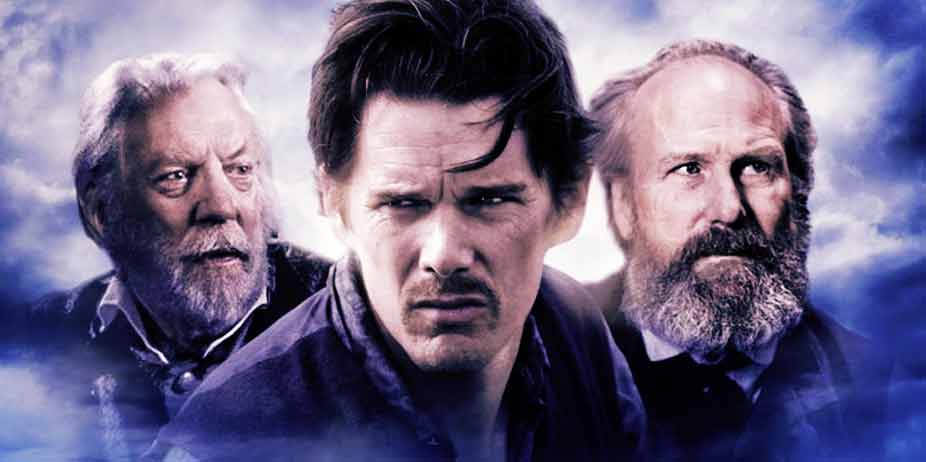
Some things in life you let go, and some things you hold on to. Revenge is one of those things, and is heavily on the mind of Captain Ahab (William Hurt), the captain of a whaling ship that lost his leg to a great white wale named Moby Dick. While his ship is in the dock undergoing extensive repairs after the near-fatal encounter with the angry sperm whale, Ahab is intent on returning to the sea and hunting down the whale that cost him so much. His wife Elizabeth (Gillian Anderson) fears that this may cost him his soul, since her repeated appeals for him to forsake this madness and return to the church are ignored. Since he is intent on sailing once more, his first officer Starbuck (Ethan Hawke) is determined to find him the finest crew available... and that includes first-time whaler Ishmael (Charlie Cox). An ambitious and eager young man who has formed and unlikely friendship with a "noble savage" named Queequeg (Raoul Trujillo), he has no notion of what he is in for.
The crew assumes this is to be just another voyage, little realizing that their captain is so intent on revenge that his demented pursuit of revenge will carry them to the ends of the sea and possibly into the watery depths, where looms the sinister shadow of Moby Dick.
One of the strengths in this adaptation that stands it out from the others is its female presence in the first half. The introduction of Ahab's wife and her interaction with him prior to this voyage provides a poignant, ominous tone to all that follows. The miniseries has a certain sense of humor, which is surprising, but also contains some lovely scenes between various characters as friendships develop and deepen. The characters are all memorable in some sense and we find ourselves torn between the loyalty Starbuck has for his captain and his own concerns about pursuing revenge. Christianity features prominently not only in the names and symbolism (there is even a prophet in the village named Elijah who warns Ahab that this journey will cost him his life) but also in the lives of certain characters. The night before their departure, the entire crew attends a church service in which the pastor (Donald Sutherland) speaks on the topic of Jonah and the whale. Starbuck has a reputation for his devotion to God and scripture, and usually is the voice of reason. Paganism is present as well, between minor members of the crew, and Captain Ahab buys into the crew's superstition by encouraging them to use native "magic" on the harpoons.
I was impressed with the authenticity of the costumes and scenes at sea, even if the CGI for Moby Dick is completely unrealistic. That kind of taints the overall experience and lessens its effectiveness (much better would have never been seeing him underwater) but overall it's a great miniseries, without too many problematic elements. Our introduction to Queequeg is him entering a room at the inn under the assumption that he is alone -- in the nude. It's so dark in the room that his bare backside is mostly obscured with shadows. There is a fair amount of swearing (minor profanities only) and a couple muffled uses of GD. Ahab mocks the fact that Starbuck has "Jesus Christ as a personal friend," but His name is never used as a profanity. An argument between a crewman and an officer escalates to a sanctioned fist fight in which they pummel one another, and then one bashes the other's head repeatedly against a hard surface. The captain allows it to continue for a time and then orders them to stop.
On two occasions, the crew is seen whaling -- chasing after and harpooning whales (we see the harpoons go in, and hear the whale's distress); ultimately, the animal wearies and is killed, then sliced up and boiled down to make oil (most of this is non-graphic). But these expeditions lead to grave loss of life -- whales dive and drag down small crafts with them, drowning the occupants; they upturn boats and throw the occupants into the sea; Moby Dick rams a ship and splinters it in half; many deaths occur but they are not particularly explicit in their depiction -- men simply vanish into the water and never come up again. The undercurrent of the story is Ahab's struggle against Moby Dick, and his struggle against God. It's an interesting religious study presented by a group of magnificent actors and far less difficult to wade through than the original book.