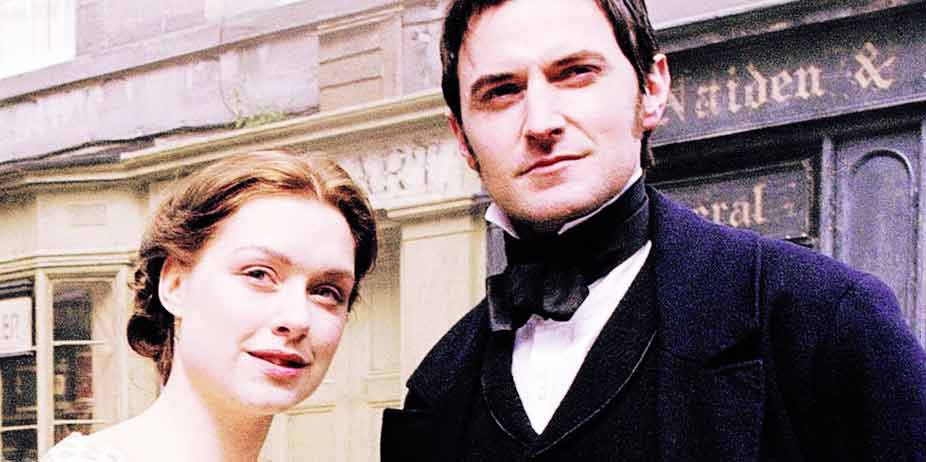
North and South (2004)
The Hales are a well set family in society, respected by most of the Southern parish in which they reside. Their only daughter Margaret (Daniela Denby-Ashe) is a spirited contrast with her father's mild manners and mother's demure nature. Formerly a local cleric, her father astonishes the family by uprooting them without explanation and moving them to the industrious town of Milton in the North of England. Accustomed to slow-moving Southern provinces, Margaret has difficulty adjusting to the booming business district. Her father has made the acquaintance of a man by the name of Thornton, who has promised to help them locate a house at a reasonable price. Already insulted by the rumors circulating about why her father chose to leave his profession in the church to become a teacher, Margaret's first impression of John Thornton (Richard Armitage) is less than favorable. She finds him inflicting brutal punishment on one of the workers found smoking in the cotton mill.
Her accusation that his behavior is hardly gentlemanly sets both immediately at odds, and she hopes never to see him again. But as fate would have it, Thornton has come to her father (Tim Pigott-Smith) for theology lessons and a reading companion. Her immediate dislike of him gives her empathy for the workers in his mill. One of the town's more outspoken union workers, Higgins (Brendan Coyle) wants the mills to raise their wages, and proposes a strike. Despite warnings from the mill workers, who are facing financial difficulties due to low production and high overhead, that their demands will not be met, Milton becomes a silent breeding ground for contempt as the strike stretches from days into weeks, with neither side showing any indication of giving in. In the meantime, Thornton discovers that he is developing unreciprocated feelings for Margaret, and his ambitious mother (Sinéad Cusack) "attempts to like her" for his sake.
North & South has been compared to a certain extent with Jane Austen's Pride & Prejudice because it carries the same common thread: primary characters who form an immediate dislike for one another, and must overcome personal prejudices to see the potential in their romantic relationship. Admittedly, Thornton is a suitable contrast with Darcy and they share many similarities in their assumptions, but Thornton has the added benefit of being a working man who has managed to rise above poverty into a medium of success. What's more, everything is placed in jeopardy through events that he cannot control. Even if you disagree with his methods, you cannot help growing a certain fondness for him. They seem to be real, with faults as well as virtues. No character is perfect and yet none of them are truly loathsome. They are all interesting, down to the smallest child. No one is forgotten and yet exploring their history never bogs down the story. There is a very different feel to it, through the camera crew's deliberate use of interesting angles that never become distracting. The cinematography is just breathtaking and it's well paced.
Eventually we learn the reasoning behind all of their actions (moving to Milton so suddenly, why Thornton reacted the way he does, and why the Hale never speak of their son). It has some truly beautiful acting, and the costumes are lovely. There are differences between the book and film that are noticeable but not overly dramatic, such as the concluding scene taking place in a train station rather than a drawing room. The BBC also rectified a former mistake made in Wives & Daughters by allowing our protagonists to actually kiss. I have not even mentioned the sub-characters, which include the feeble Mrs. Hale (Lesley Manville), Thornton's arrogant younger sister Fanny (Jo Joyner), the likable housekeeper simply called Dixon (Pauline Quirke), and a host of mill workers, each with a set of unique problems.
What I liked the most about this film were the relationships portrayed. I appreciated the role that Mrs. Hale played in her son's life, empowering and yet not stifling him. I also loved how history was incorporated and the filmmakers made a conscious effort to have everything as accurate to the period as possible. If nothing else, you will gain information about a very dramatic time in the Victorian era, when machines were taking over the industry and unions were forming to give workers more rights. They also presented both sides of the argument, allowing the audience to choose sides based on their preferences and set of beliefs. A much bigger picture was outlined to illustrate what happens when strikes influence the market, and how much negative affect it can eventually have on the industry. Throughout much of the film, I was constantly surprised by the turns the script took, and only toward the conclusion did the ending become obvious. Even then, the audience is so happy that pre-guessing doesn't matter.
There are no overt content issues, but thematic elements and mild profanity do play a role. A half dozen uses of d**n are referenced, along with the scriptural use of "go to hell." Margaret overhears two men wondering if her father was forced to give up his parish due to wandering hands. Thornton is shown punching and kicking a mill worker caught with a lit cigarette in the cotton room. The same man comes to re-apply for a job, and is pushed out into the street. A mob riots, breaking through doors and threatening to storm the mill. One of them throws a rock that strikes someone in the head. Thornton becomes rough with Margaret in trying to force her inside so that she won't be harmed by the crowd. Soldiers beat on the rioters with wooden sticks. A fistfight erupts between two men at the train station, and one of them is pushed down a flight of stairs. Several dead bodies are recovered from the street.
We learn that Margaret's father left his position of authority in the church because he could not agree with current theology concerning new prayer books. He has not given up on God, merely refused to preach something he does not believe. Higgins does not question the existence of God, but finds it cruel that He would place us into such a dark world. Mr. Hale' response was reasonably favorable on behalf of faith, but could have been a little more illuminating. Margaret often questions Thornton's motives and accuses him of being uncharitable; he responds that he is attempting to make a profit, not to run a charity, but over time shows a more compassionate nature. She is forced to live a very serious lie in an attempt to protect another person, and others cover up for her. I felt it was a very good film, worth the trouble I went to in procuring it. It's even better than some of the BBC's recent masterpieces, and you may just find a new hero and heroine in the repressed, brooding, Mr. Thornton and his impetuous antagonist, Margaret Hale.