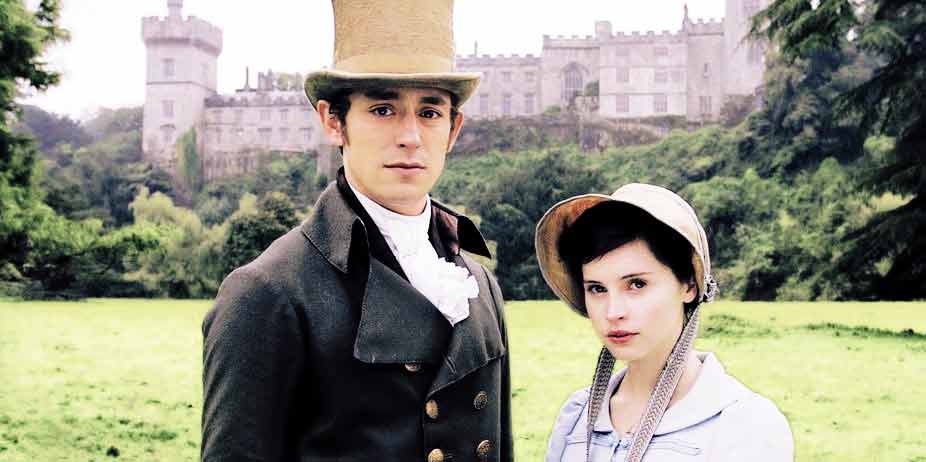
Northanger Abbey (2007)
There have been more Jane Austen adaptations than a fan can count, but Northanger Abbey is one book that has remained relatively untouched through the years. Perhaps because it is fanciful, or because the heroine is rather distracted, or maybe it merely stumps screenwriters because of its unusual themes. Whatever the cause, Andrew Davis got his hands on it, and this is the result.
Of the utmost excitement to any young woman in the modern age is the Gothic romance novel, full of heaving bosoms and dashing heroes rescuing fair maidens from evil villains with the strike of a hand or the thrust of a sword. Catherine Moreland (Felicity Jones) lives for these volumes, hastening to the local book shop to purchase whatever new title happens to catch her fancy, and spending hours discussing the books with her friends in intimate whispers. Recently transported to Bath for the season, it does not take Catherine long to make the acquaintance and friendship of Isabella Thorpe (Carey Mulligan), who shares her passion for literary romances, and introduces her into society. Within this gathering of people is Henry Tilney (JJ Field) and his sister Eleanor (Catherine Walker), both of whom become very fond of her.
Through a series of circumstances, Catherine winds up at their estate, Northanger Abbey, and her overactive imagination leads her to suspect dark things of their father (Liam Cunningham). It seems that Mrs. Tilney died under suspicious circumstances while her children were out of the house. The result is an entertaining way to spend two hours that contains none of the brilliance of the book, but is nevertheless engaging. Felicity is one of the more beautiful girls cast in a leading lady role in the most recent onslaught of BBC Austen costume dramas, and her enormous eyes and whimsical mannerisms are ideal for Catherine, who has become a little too involved in her gothic romances to be entirely sensible. But it is Cunningham who succeeds in stealing most of his scenes, for he is a little too interested in Catherine, and a little too dark-tempered to be entirely above suspicion.
In some respects, I feel Davis in his usual sensuality-craved style enjoyed toying with the motivations behind the actions of most of the main characters; he has certainly succeeded in slipping in just enough sensuality to be mildly problematic without becoming overly offensive. Isabella is seduced and left by a scoundrel; we see her wrapped in bedclothes, attempting to persuade him to reassure her that they will be married now, but his disinterest is evident. More troubling is a dream Catharine has in which Henry comes across her bathing in the woods, and pulls her up out of the tub, presumably seeing her naked. (The audience gets a grand view of her bare back.) In the American release, these scenes have been removed. In other delusions, she envisions herself as various damsels in distress from her fanciful books, always in some peril from an ill-meaning villain. There is some violence present in these melodramatic flashes, along with a good deal of humorous over-acting.
Where Persuasion was dull, and Mansfield Park passionless, Northanger Abbey is actually a decent film. The production value is reasonable and the actors have a nice sense of chemistry together, whether it is between friends or potential lovers. It is all too easy to see the mistakes Catherine makes, and this forms her into a likable and flawed character who is entirely human. She is not above chastising her own behavior, or learning from her mishaps. Fortunately for Catherine, mistakes can be overcome with a little humility. The same could be said of the film itself, for it does founder on occasion but in the end leaves the audience with a smile on their face.