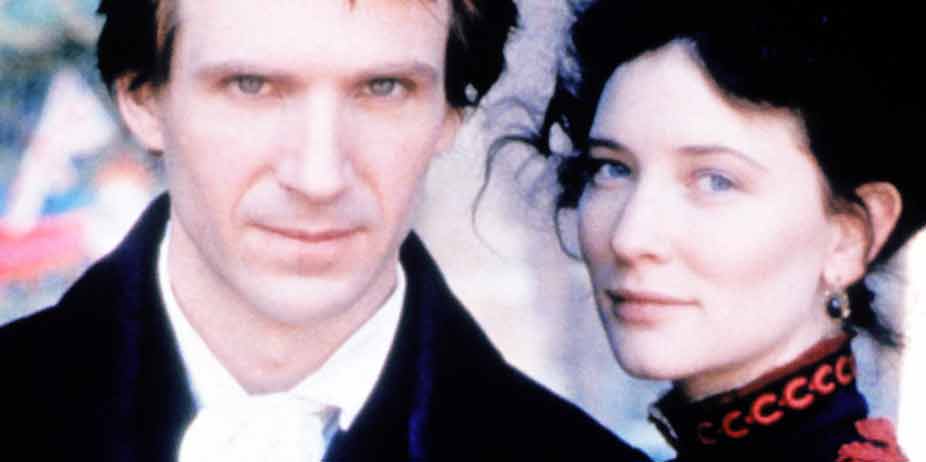
Oscar & Lucinda (1997)
I love this film. I cannot fully explain the reasons why, but it simply touched me deep inside and became a favorite. After her success with Little Women and before Charlotte Gray, director Gillian Armstrong gave us Oscar & Lucinda starring Cate Blanchett and Ralph Fiennes. Its a dynamic pairing, and both play their roles with vivid passion and intelligence. But as much as it's enthralling, it's also very melancholy and viewers should anticipate a less than happy ending. You will either love or hate it for its subtleness. I happen to have a singular fascination for its slowly unfolding romance. It's a great tragedy, but also extremely thought-provoking. It demands mature viewers prepared to deflate dubious theology and see beyond its obvious flaws.
Oscar Hopkins (James Tingey) is an aqua-phobic and the son of a strict religious minister in southern England. His father has denounced Christmas as a pagan holiday and when the cook chances to give Oscar some Christmas pudding in secret, the poor boy is punished. Unable to believe such a delightful treat could be the food of the devil, Oscar is driven to ask God if his father is in the right. Coming up with a complex series of figures, he wagers his future on chance. With every fatal throw of the stone across the chalked slats which indicate the different denominations, it comes up the same -- Anglican. To the wrath of his father, the disappointment of the congregation, and the delight of the local Anglican minister, Oscar leaves home and becomes the ward of Reverend Hugh Stratton (Tom Wilkinson) with the intention to become a pastor.
Thousands of miles away, Lucinda Leplastrier (Cate Blanchett) has inherited her mothers vast fortune. The young woman has an ardent fascination for glass, and when taken to Sidney intends to purchase a glass works. She seeks help from local minister Dennis Hasset (Ciarán Hinds), who has collected glass since his childhood. But her affinity for gambling brings disgrace to his noble name. In the meantime, Oscar (now played by Ralph Fiennes) has begun seminary, and one of his associates introduces him to the fine art of gambling. Unusually successful, Oscar keeps only what he needs and gives the rest to the poor. Reverend Stratton believes the boy to be engaged in something illegal or immoral, and Oscar in turn determines to abandon his addiction and go to New Wales to begin a ministry.
On his voyage to Australia he meets the likable but eccentric Lucinda, who calls him to her stateroom under the pretense of confessing. Truthfully she is lonely -- and the pair inadvertently stumble across their shared passion -- gambling. Over a game of cards, an unlikely friendship forms which will eventually progress into a beautiful romance. But the two gamblers will be torn apart, and when Oscar determines to prove his love for Lucinda, it will accumulate in a dangerous wager which will test the strength and folly of both. A playful but dark adaptation of the best-selling novel by Peter Carey, > Oscar & Lucinda is an enthralling but ultimately sad story about two very different individuals who find themselves fulfilled in one another. Oscar is the square peg in a round hole, a young man who "doesn't fit" in with his peers. Lucinda is the pants-wearing tomboy with a childlike innocence. Together they form a complete picture; their faults play off one another's strengths. The characters are likable for their faults and strengths alike.
Rarely is there such a delightful pairing, but viewers should be forewarned this touching romance ultimately ends in tragedy. The depth of the scenes almost displaces the difficult storyline, which is at times hard to follow if one has not a good grasp of 19th century ideals. The story is filmed exquisitely, and has two outstanding performances by Cate Blanchett and Ralph Fiennes. The acting in the production is some of the best I've seen more is expressed through glances and movement than words ever could. The supporting cast (including Richard Roxburg in the role of a shockingly devious explorer) is standout. The value of the production is also impressive, with beautiful period costumes and staterooms. But it's the depth of the film which manages to worm its way into your heart, even with some extremely obvious content and religious concerns. We empathize with the characters to such a degree that we're willing to overlook their failings in the greater good. Were it not for Oscar and Lucinda's gambling problems they would be ideal role models.
There are some extremely misguided religious views in this film. Oscar professes something near blasphemy in one scene -- that gambling cannot be a sin, for God asks us to gamble our soul in the belief that He exists. Lucinda chastises her friend Reverend Hasset for "preaching what you do not believe to men who do not care." (He does "not believe in the virgin birth.") Reverend Stratton pleads with Oscar for the secret to his gambling success and then, after digging himself into poverty through his addiction, kills himself (therefore "condemning his soul to hell for all eternity"). Mingled with these slights on religion in general are very poignant passages which reveal a deeper, more pure form of Christianity. Though misguided, Oscar's version of faith is most profound than any of the other ministers we meet in his journey of fate. His faith in God is never shaken and he rebukes himself harshly for his flaws. There is nothing overly offensive about the films ideals, but nothing to make it worthwhile either unless one can count the simple lessons of charity, kindness, and faith the major players have to offer.
In one poignant scene, Oscar kneels before his chair and pleads with God to forgive him for everything that he has done amiss. (For leading Stratton astray, for betraying Lucinda, and a number of other incidents in his past.) He takes full responsibility for a situation pressed on him by another, less-worthy person, and shows remorse when responsible for a man's death. Should viewers decide to traverse Oscar & Lucinda despite its religious inconsistencies, they should also bear in mind the film's cultural flaws. While profanity and other minor cautions are almost obsolete, there are several sexual insinuations and some violence. Natives are brutally killed by an explorer. In a fit of fury over a quarrel involving funds, he brutally attempts to take a saber to Oscar. The end result is his death when one of Oscar's friends hacks him once in the arm with a hatchet. Terrified and not thinking clearly, Oscar then takes the weapon and impales him in the head with it. (No visibility; the hatchet is brought down, some blood sprays the attackers chin and hands and the man drops.)
Several times, due to his fear of water, Oscar is driven to near-madness. He is wrestled to the ground in one scene and forced to take medication. One suggestive scene involves a native woman in a bar, presumably a prostitute; several men visit her behind the curtain but there's no obvious movement. (We do see a man drop his pants and fall onto the bed beside her, giving us a glimpse of his bare backside). There's also brief rear nudity of aborigine children. While both scenes are short and could have been overlooked, the most offensive encounter in the film comes when Oscar, faint with illness and fear from a river voyage, is tended to by the local widow, who takes advantage of his instability and compromises him. While there's no visible nudity, the scene is unnerving. Even fast-forwarding it you still catch a lot of movement. It does have a purpose in explaining the ending but is more gratuitous than necessary. Its flaws make Oscar & Lucinda a memorable but troubling film which sends too many mixed signals to get the clear go-ahead.