 The
Pianist (2006)
The
Pianist (2006)
A movie that took audiences by surprise and swept the Oscars (not to mention took home Best Picture at Cannes) is Roman Polanski's The Pianist, the true story of Wladyslaw Szpilman, a Jew and concert musician during the German invasion of Poland. Though graphic in some of its depictions, one would be hard pressed not to come away with your heart strings tugged. I would encourage older viewers to see this at least once. A film like this can prove a worthwhile tool to help us understand the nature of evil, and create in us a desire to fight it all the more passionately.
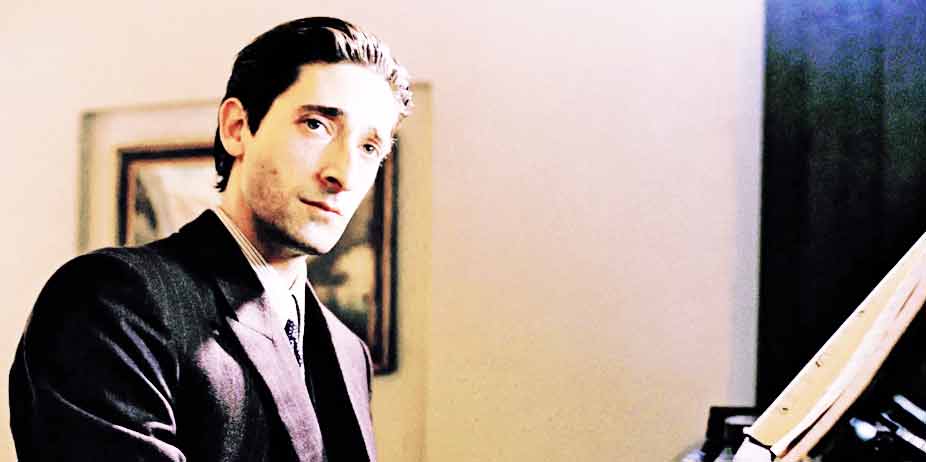
In a small radio theatre room in Warsaw, Poland a young man (Adrien Brody in an award-winning role) plays a piano over the air. His lean fingers pick out complicated pieces of Chopin and other great composers while a hailstorm of bombs erupts in the city around him. Playing until the last possible moment, he's forced to abandon the radio station along with hundreds of other employees, guests, and visitors. The Nazis are invading the city and seizing control of all communication points. On his way downstairs he meets a beautiful young woman named Dorota (Emilia Fox) who has come to the station to meet him. Their friendship begins to grow even as Szpilman's family feels the pinch of the Germans all around them. It begins with a limit on how much money Jews can have in the house. It moves to forcing them to wear armbands with the Star of David imprinted on them.
Then it progresses to making them walk in the gutter, or having Nazi soldiers force them to dance in the street at gunpoint. Eventually Szpilman and his family, along with all of the other Jews in the city, are forced into confinement in the ghetto. From there, things only get worse. A family is chosen at random and murdered. Their houses are ransacked. Children are murdered trying to slip out of the ghetto. The Nazis let hundreds of people starve to death. As the young pianist fights for his family, soon he will be forced into playing a horrible game of survival. Movies of this nature are exceedingly difficult to watch and just as grueling to film. The director has done a fine job pouring his heart and soul into every frame of the camera. Adrien Brody, who won an Oscar for his efforts, is an empathetic presence on screen, equally engaging while never completely overpowering the audience. The viewer is left with a sense of having been in hiding... of seeing horrible things from behind curtained windows or a darkened street corner.
By nature I loathe Holocaust films, but this one was touching enough I never regretted viewing it in its entirety. The scenes of brutality on the part of the German officers are unforgivable. But by the end, as we witness the compassion of one high-ranking German official, we wonder if the good deeds of one can outweigh the thousands who have inflicted evil. The final few scenes are spellbinding. I won't apologize for the violence, but instead say I felt the director handled it as delicately as possible considering the inhumanity of WWII. Most of it is shown in far-away shots so as not to spatter the audience with feelings of revulsion over watching such a thing. But due to the heartless nature of it, these scenes will stay with you for a long time. The Szpilmans are dining one evening in the ghetto when they hear a German truck drive up the lane. As all the lights along the street are extinguished, they watch from windows as an atrocity unfolds. The Germans invade a house, throw a wheel-chair bound man over the balcony to the street below, then herd the family out into the street and shoot them all. As they drive away, they purposefully run over the bodies, leaving carnage and blood in the street. (We see all this from an upstairs window across the street.)
That's merely one example. Brutality is implied but only occasionally seen. An officer beats Jews to celebrate the New Year. He calls forth eight men from a line of workers and shoots all of them in the head. A little boy trying to squeeze through a fence is beaten to death (unseen). Bloodstained bodies lay in the street. Bodies are piled together and burned. It sounds absolutely horrible, but in actuality most of the shots are pretty far off and aren't overly gruesome. I'd prepared myself for much worse. There are also three f-words, along with general mild profanity. The film does seem overly long at two and a half hours, but the final thirty minutes involving a German officer who saves Szpilman's life, is utterly touching. One feels the horror of war, the anger toward the German troops, and a painful cry of "WHY didn't the world do something sooner?!" as the film unfolds. But by the end we've seen one man's story of struggle and triumph in a world enveloped by darkness.