 Public
Enemies (2009)
Public
Enemies (2009)
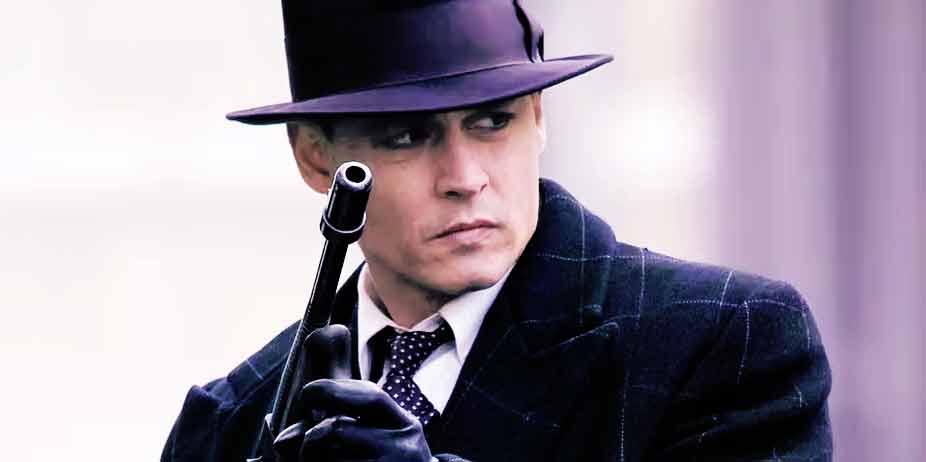
One of the most notorious criminals in recent American history is John Dillinger. Known for pulling off multiple bank robberies in the late 1930's, he rapidly became "Public Enemy #1" according to the Federal Bureau of Investigation. Portions of the last year of his life have been brought to life in this semi-biographical film.
After serving ten years for a botched robbery attempt against a local store, John Dillinger (Johnny Depp) has not been out of prison long when he returns to it -- this time to participate in a jailbreak and free his criminal "associates" from state custody. Exchanging gunfire with the authorities and losing several good men in the process, he and his gang return to their hideout and consider their options. It seems that the most profitable means of making money is through robbing banks, and soon they become proficient at it. Hostages are frequently taken and then released, with no one being seriously hurt (minus a knock on the head here and there). Their immense success soon turns federal investigators into a laughingstock and forces J. Edgar Hoover (Billy Crudup) to restore public confidence. He turns the investigation over to the experienced and ambitious Melvin Purvis (Christian Bale), who uses advanced techniques to draw ever-closer to their elusive adversary.
Dillinger in the meantime continues to play a game of cat and mouse with the authorities when not romancing a beautiful "coat checker" (Marion Cotillard). It's only a matter of time before these equally driven men cross paths and come to a violent showdown. Not knowing much about the real story, it was an interesting introduction to the career of one of the most infamous bank robbers in history, but in reading further about the real story, I discovered much of the events portrayed herein are fictional. Events are rearranged or altered and that prevents it from being entirely accurate; in some instances various characters are made out to be less "evil" than they were in real life, and in others, tactics and torture methods are used that seem villainous given the circumstances (I might add, however, that while this particular woman was not "interrogated" in such a manner, another woman in a similar situation was). One thing that surprised me was how fond we become of Dillinger in spite of his status as a criminal. I actually got up off the couch and pulled an Encyclopedia off my shelf midway through, because I couldn't stand not knowing what was going to happen.
Although certain events shown are falsified, there is a great deal of poetic symbolism present. A fictitious meeting between Dillinger and Purvis really showcases the actors' talents and their grasp of their individual characters. Depp and Bale both turn in strong performances and have a great supporting cast (including David Wenham, Carey Mulligan, Emilie de Ravin, and Leelee Sobieski). The movie has a very unique feel to it and beautiful costuming and set design. It's very atmospheric. There are long periods of lesser action and a few truly terrific shoot-outs. In terms of storytelling it begins a little weak and confusing (it assumes the audience is familiar with history, and so if you're not, it will take time to "catch up") but significantly improves in the second half. Some have complained that it's "slow" but even they are forced to admit the pivotal two scenes are impressive: one is the FBI attempting to take out Dillinger and his associates in a remote woodland cabin, and the other is near the end. One of the greater ideas is the introduction of a black and white Clark Gable film about a gangster, which foreshadows the significance in what is to happen in the last few minutes. I think that goes a long way in preparing the audience for the inevitable end.
Public Enemies was shot with an R-rating in mind and makes good use of it in terms of violence and one brief and clothed sex scene but is not as brutal as I expected. I anticipated more foul language than there actually was -- the f-word makes only one appearance, but there are six uses of GD, one abuse of "Christ," and some mild profanities. There's partial nudity of a woman in a bathtub; she invites a man to join her, and he intends to but is interrupted. He presents her with a fur coat and she thanks him for it by sleeping with him (in an... unusual position, I might add). There is an enormous amount of violence but only some of it is bloody; bullets take out many people in a half dozen scenes that feature gunfire; people are frequently killed. Blood sometimes spurts from the wounds, or is shown pooling on the ground around the bodies. Someone is shot in the back of the head. A woman is slapped several times across the face, hard enough to leave bruises and split her lip. Elsewhere are punches and scuffling. A car is shot off the road and turns over. An injured man is tortured for information. There is a decent amount of drinking and some smoking.
The frequent use of God's name in vain and the sex scene prevent me from recommending this too readily, but I enjoyed it as a rare throwback to the films of the 1930's. It takes an interesting approach and is likely to fascinate audiences enough to research the real men involved. It's entertaining to watch and also provides us with a glimpse into the mind of the man that managed to elude federal custody and escape prison multiple times (sometimes with extreme cleverness). It's the sort of movie that implies a natural following and while most people agree it is "missing something," the fact that Depp hasn't been nominated for an Oscar for his role is an absolute crime.