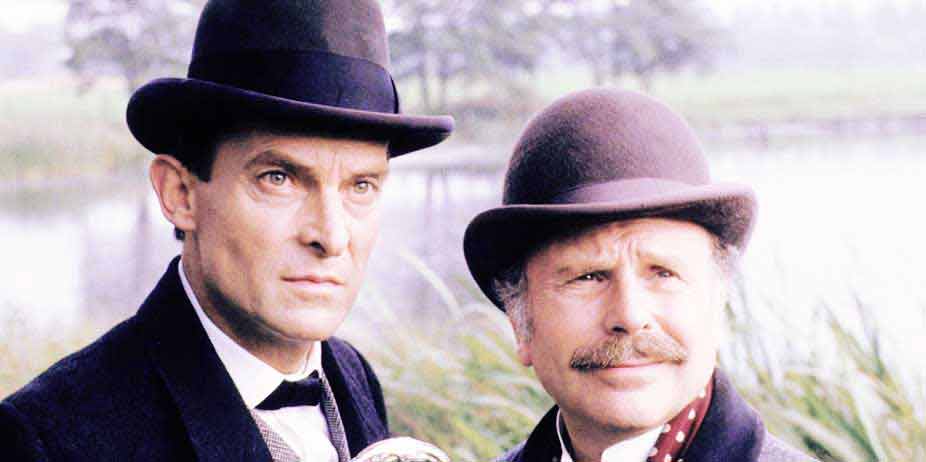
 The
Return of Sherlock Holmes (1987)
The
Return of Sherlock Holmes (1987)
Originally created for the BBC by Granada, this consists of the popular series adaptations of the stories by Sir Arthur Conan Doyle. Lovers of good mysteries in general will appreciate these noteworthy attempts at recreating Holmes as much as the die-hard fans.
The Empty House
It has been three years since the unfortunate death of Sherlock Holmes, and Dr. Watson has set himself up in a criminal medical practice. He is often called to determine the time of death and circumstances surrounding sordid affairs. On this particular instance it's to the home of a young London socialite who was murdered during the night. The room was locked from inside with no visible signs of violence other than the bloodstained body sprawled out beside the desk. The death was brought on by a bullet to the head, which was found nearby. Watson finds the event singular but has not his former friend's deductive reasoning powers. He attends the coroner's jury to give his report and listens to the evidence supplied by the lad's friends and family members.
On his way out, a bent-over bookseller scatters his wares in the street. Watson lends him a hand and is rudely pushed aside. Several hours later, the man turns up on his doorstep to apologize for his rudeness and offer to sell him a few books at a reduced price. Watson turns aside and when he looks back, none other than the dearly departed Sherlock Holmes stands before him. The doctor keels over in a dead faint, and after coming around demands the entire story. Holmes morosely informs him the struggle at the falls in Switzerland were not as he supposed. Moriarty did plunge to his death that day, but Holmes remained on secure ground. It occurred to him that pretending his own death was instantaneous would give him protection from Moriarty's allies, one in particular who was still at large.
Clambering up the falls into a sheltered alcove, from there he observed painfully the horror of Watson and the rapid police investigation. Then he escaped into the world beyond, literally fleeing for his life. He has now returned to bag the creature who is second only to the late professor in the annuals of crime, the very man who has planned Holmes' own death... and that of the poor socialite. The nuances and delights of this tale remind the viewer of what we so enjoy about Sherlock Holmes. His eccentric habits, his moments of deductive reasoning, and occasional glimpses of emotion. To say nothing of his "love for the dramatic," which gives poor Watson the start of his life. Mrs. Hudson is also party to his unexpected arrival, and the grace and majesty with which she welcomes him back to the flat are charming. Having long-suffered his bad temper, the endless smoking in the rooms upstairs, all manner of sinister visitors coming at all hours of the day and night, and even the patriotic insignia emblazoned on the far wall with revolver bullets, we can see for all her early protests, she's very glad to have him home again.
The crime is not a singular one, for the story centers primarily around Holmes' dramatic return. The conclusion is satisfactory as we find the trio safely installed back in Baker Street, with Holmes happily smoking his favorite pipe, Watson exhilarated with the knowledge their adventures will continue, and Mrs. Hudson toasting her good friends. There is one slightly corny struggle between several men in a darkened room. Several times Holmes is nearly killed, either by attempted tranquilization, being shot at from a great distance as he attempts to flee, or having been knocked around the head. A bloodstained sheet covers the body, which we never observe. The crime is seen in flashback but we don't witness the impact, only the faint noise of the bullet and a body crumpling to the floor. There's one minor abuse of deity.
Observing the series in sequence ads an air of relief and exhilaration much like that of Watson when at last Holmes appears. The first ten minutes seem to plunder along for our doctor, as charming and amiable as he may be, holds not a candle to his friend's explosive presence. The moment Holmes steps back into the sequence of events, the viewer is almost relieved with his appearance. We hang on every word, anticipating the tale we now know so well. The fact that the BBC has managed to recapture the sensation Strand readers felt when they read the words, "... When I turned again, Sherlock Holmes was standing smiling at me across my study table..." is nothing less than remarkable. They've done their job well.
The Abbey Grange
Watson is shaken awake in the early hours of the morning by a nervous and excited roommate, who informs him to dress and come along to the train station on a matter of some urgency. As the train carries them into Kent, Holmes reveals a peculiar and agitated wire sent to him by Inspector Hopkins. But when they alight at the station, the inspector informs them dourly he may have acted in haste. The woman in question has cleared up the situation with an explanation. Nevertheless Holmes is asked to investigate further. The crime is believed to involve a trio of known murderers, and the victim is the late Sir Eustace Brackenstall, one of the wealthiest men in the country. The preceding evening, his wife Mary had gone about her usual rounds of the house, making certain all the windows were latched.
Having come into the drawing room, Mary was startled by an open window. A figure appeared through it, and struck the candelabra from her hand. The blow sent her unconscious to the ground. Wavering in and out of consciousness, she was aware of her husband's still form laying on the carpet in front of her, and three figures clearing the room of its valuables. Her description fits the profile of a known thief and murderer who for some time has evaded the police. Mary was bound to a chair with the bell-pull cord, and left to be found by her companion later in the evening. The police were immediately sent for, who in turn called for the assistance of Holmes. The Baker Street sleuth can find no complaint with the solution and yet is unable to satisfy himself as to all of the minor details.
His initial return to London is drawn short when inexplicably he chooses to return to the house, and press further the issue. His investigations turn up a series of complex little clues which lead to the unveiling of the truth. The Abbey Grange has one of the more unique endings to the canon, as well as offers a glimpse into Holmes' more compassionate side. One of the episode's best moments is when Mary Brackenstall throws herself at him in wild relief. The expression on his face as he disentangles himself from her arms is priceless. The flashbacks also contain a strongly romantic element which I could not help but enjoy. The costuming in this particular instance is dazzling with a beautiful gown of jaded silk eventually stained with blood. But some of the camera angles are poorly chosen, and the corpse is gruesome.
The episode opens with the discovery of a bloody body, eyes staring wildly in terror, and hand outstretched as if to grasp his opponent. We see the corpse thus several times, as well as the trail of blood staining the carpet beneath his head. The actual crime is witnessed in flashback, but we glimpse only the attacker's face as he drives the blow, and then the shocked expression of his companion as he falls. Blood sprays across the gown of the unconscious woman on the floor. She has a mottled series of bruises surrounding her left temple, and several devious marks upon her arm. There are discussions of domestic violence and the murder of a small animal in rage. Holmes takes it upon himself to act as a judge and jury; the result may not please all ardent viewers. Mary is struck to the floor. In a rage, a man calls a woman a whore and harlot. There are several mild profanities and one abuse of deity.
This isn't one of my favorite adaptations but there's nothing wrong with it on a purely superficial level. The last half hour is the most intriguing, and to see Holmes pull himself out of calculating mode and show human emotion is worth any minor discrepancies.
The Second Stain
Sherlock Holmes is known for his inclination to handle curious and extraordinary affairs. Several times throughout the canon, cases of a highly political nature are brought to his attention, usually under the most strenuous of circumstances. One such case is The Second Stain, a primarily political adventure which rapidly turns murderous. Two gentlemen from the Department of European Affairs arrive on Holmes' doorstep one cheerful midwinter morning bearing bad tidings. Ron Trelawney Hope (Stuart Wilson) has been entrusted with a document of great importance. It was written and posted in secret to their foreign office by a European dignitary whose very life could be jeopardized by the knowledge of its existence. It was to be handed over to the Prime Minister immediately, but placed in his case box and taken home the previous night.
Sometime during the hour of eight when last he checked the box, and this morning when it was unlocked, the document in the eggshell-blue sealed envelope disappeared. They cannot involve the police due to the scandal which would arise. The document contains elements to propel England into war with its publication, and Hope pleads with the great detective to undertake the case. His employer Lord Bellinger (Harry Andrews) has no desire to give Holmes particulars of the document's contents, but when the detective refuses to blindly act in their favor, he's granted some minor knowledge to assist him with the case. Not an hour after the men's departure, a woman appears on their doorstep. Lady Hilda (Patricia Hodge) is the wife of their client. Her husband has told her nothing aside from that an important envelope has been stolen from his things. She pleads to know any or all details in reference so she might have some knowledge if it will damage her husband's political career.
Holmes denies her any information. "The motives of women are so inscrutable," he complains to Watson. "How can you build on such a quicksand? Their most trivial action may mean volumes, or their most extraordinary conduct may depend upon a hairpin or curling tongs." One of his primal instincts leads him to believe the envelope will be sold on the black market. If so, there are three agents in London he knows might profit from such a purchase. The case is considerably complicated when his prime suspect turns up in the newspaper headlines... murdered. Lestrade (Colin Jeavons) has been assigned to the case, and turns up a most sinister and peculiar chain of events. The two crimes entwine into one of the most fascinating of his career. The plot is very apt and the pace rapid enough to carry the viewer's interest even through some of the political maneuverings. Though the one responsible for the theft of the documents turns out to have quite a different motive than initially suspected, the story is believable.
The writers have done well capturing the subtle nuances of the original tale. Jeremy Brett is in his element as Holmes, and proves astonishingly likable while always humorous. The sight of him tearing up a rug in a police inspector's brief absence and searching the floor frantically before repairing the damage done and throwing himself back into his chair on the constable's return, is true Doyle from beginning to end. Edward Hardwicke is something of a less good-natured Watson than his predecessor, but this is one of the episodes which mark him as the definitive sidekick. I also adore the portrayal of Lestrade, who is something of an egotist but seems to be digging for approval from his mentor and hero. The interaction between them is always charming and here you can practically feel the intense rivalry between them, though it's all carried out under a perfectly respectable mutual appreciation. Are they friend or foe?
We briefly witness in a flashback the murder of someone in a fit of rage; we very briefly see the impact of the knife before whirling into another sequence of events. There are a couple of mild abuses of deity. The positive far outweighs the negative and while the final shot of the episode is rather out of character for the great detective, it nevertheless brings a smile to the viewer's face. This is one of the few episodes in which the true nature of Holmes shines through to reveal a secretly compassionate man. The final scenes underline a lesser-known attribute; his ability to understand and forgive as opposed to condemnation and public humiliation. He gives up a great deal in order to secure the outcome. That's one of the things I like best about him, and in this instance, even the most determined viewer would be hard-pressed to find a complaint in his performance.
The Six Napoleons
Along a crowded little street in a worn-down part of town, a burly figure watches a girl across the lane through a shuttered window. Behind him two voices are raised in violent, angry Italian as they scream insults at one another. The woman is slapped. The man storms from the house. He screams up at the house, and kicks the front steps. He runs down a nearby alley and comes on a group of workers at the local bust factory. Singling one of them out, he tries to knife the man and is in turn gutted. His opponent flees into the factory, knocking over plaster busts as he goes, and is finally dragged out by the police laughing uproariously. A year later, Sherlock Holmes, Dr. Watson, and Inspector Lestrade are sharing a quiet evening in Baker Street. Holmes is pouring over one of his casebooks, Watson is dreamily sipping his evening brandy, and their visitor is almost jumping out of his skin with excitement.
An unusual case has been brought to his attention. It involves several singular break-ins, all of them involving busts of Napoleon. Two were purchased by a well-to-do gentleman in London, who kept one in his private home and the other in his office. His drawing room was broken into and the bust taken outside, where it was smashed on his front doorstep. When he arrived at his office the following morning, he found the other Napoleon similarly dismembered. It seems a strange thing for someone to do; smashing plaster rather than thieving any of the numerous prized objects in the man's collection. Watson is intrigued, believing it might have a medical association with some primary form of insanity. Holmes snorts at this speculation but asks Lestrade to inform him of any developments in the case.
The following morning an urgent message calls him to the home of a local reporter, who awoke in the night to find a body on his doorstep and his bust of Napoleon missing. The dead man has no identification but was found with his throat slit. The porcelain bust was discovered down the street outside of an empty house, smashed. Holmes is now convinced the case carries importance, but focuses his attentions on the sinister demolition of Napoleon replicas while Lestrade is more inclined to pay heed to the murder. The Six Napoleons is one of the more eccentric cases in Holmes' long history of mystery-solving. The best thing about the storyline is the interaction between Lestrade and Holmes. They are good-natured rivals, Holmes always one step ahead of the Scotland Yard detective, who never fails to drop a mild insult when it strikes him best. In one poignant moment between them, Lestrade nearly brings a tear to his adversary's eye by way of an earnest compliment.
Occasionally the softer side of Sherlock Holmes shows through and Jeremy Brett is surprisingly apt at never taking it too far. He rapidly regains composure but the audience is left touched by the brief, open vulnerability of his character. What makes the tales so enduring is not their plots, which range from the trivial to those of great importance. It's the friendship between Watson and Holmes, and the eccentric madness of the great detective as he follows a series of minute clues to a dramatic conclusion. Though this episode's opening scene seems incredibly long and often all interaction to take place between minor characters is in untranslated Italian, the story is intriguing enough to keep viewers' attention. There are very minor content issues, most of them taking place in the initial first few minutes.
The woman being watched through the window is sensuously sponging her face and neck. The people in the background are hurling insults at one another (the Italian translates to profanity). A man is found with his throat cut, with bloody, jagged results. Holmes pours over the body in the morgue, examining the wound with a magnifying glass and forcing the corpse's arm up so he might examine his fingers. The opening knife-fight is not graphic, nor are the police violent in restraining their prisoner. I really disliked the Italian influence of many scenes, which carried little significance to the story and seemed to derail the main plot line, but in all other respects it's a well-formulated mystery with a charming climax. Seeing Holmes whip a tablecloth off a small circular table without so much as disturbing the teacups, if nothing else, is worth the hour spent at Baker Street.
The Priory School
Mrs. Hudson is seldom roused after hours at Baker Street, although she's evidenced all manner of persons come through her door. When Dr. Huxtable appeared demanding an immediate counseling with Mr. Sherlock Holmes, she was hardly unable to stop him as he bolted up the door and ran into the sitting-room. Watson is startled, but Holmes only moves from his position of leisure on the couch when their client promptly collapses on the floor before them. In a considerable state of distress, Huxtable reveals he's the headmaster at a priory school in the south of England. He's followed some of Holmes' cases in the newspapers and remains convinced he's the only man in London to solve this most peculiar disappearance of one of his students.
The boy in question is the son of the Duke of Holdernesse, an esteemed intellectual and one of the inner circle to the crown. The duke is very shy of public attention and moved into the country in order to lead a solitary life. His young son was employed at the school to obtain an education, but one evening vanished... along with the Greek teacher, who has not been seen since. Neither he nor his bicycle have been found. The police were set upon the case but in the three days which have passed since the incident, have made no conclusive discoveries. Without the duke's consent, Huxtable has come to Baker Street in the hope Mr. Holmes might help them discern the boy's whereabouts.
Traveling to the priory school, Holmes finds the duke an unwilling informant in his inquiries. The boy must be found at all costs; a reward of six thousand pounds has been written for his safe recovery and the apprehension of his kidnapper. The school is old and conceals many secrets, not the least of which being the complete desolation of the moors. There's nothing but land for miles, a single road, rough terrain. It would be nearly impossible to carry anyone a great distance. But if they did travel off the main path, what has become of the Greek schoolmaster? Holmes' investigations lead him to disturbing discoveries on the vast and lonely moor, and accumulate in a daring climax against a drastic rival. Both slightly political and personal in nature, it's exciting to see him so focused and intent to the point of ignoring conversation around him entirely in an effort of gathering his thoughts.
A few subtle clues fall into place but it's Holmes' genius at piecing them all together which finally leads to the solving of the case. Someone unfamiliar with the original story would have trouble foreseeing the end, which is how it should be. The suspects are many, the surrounding moor lends a certain sense of the sinister, and some of the witty banter traded around the dinner table more than makes up for the bleak discovery of a body on the heath and a few minor profanities. There is some violence as a boy is dragged across the moor; a man falls to his death from a great height. Carrion crows pick at the bones of an animal in a stream and circle a high point, marking a man's gruesome form. We only see his half-eaten fingers but hear of his sorry state.
The conclusion is somewhat bittersweet, combing both relief and sorrow. Not all stories have a happy ending but at least they were able to save the child. The tale also raises some important questions about how far to let someone go in love, and whether or not a man should pay for his previous sins. Holmes is somewhat more meticulous than usual and this marks one of the declining episodes in the sense that the series changed both writers and directors, which influences the remaining tales with a decidedly different and not altogether likable flavor. Altogether it's a good episode but has some minor flaws, but the acting is first-rate and I particularly liked their reenactment what happened on the night in question.
Wisteria Lodge
In the lonely Sussex countryside, a carriage moves down a shadowed lane, followed at a distance by a dog-cart in which several figures are seated. Among them is Scott Eccles (Donald Churchill), who has come to the moors to investigate into a series of old maps which mark the surrounding terrain. After a dinner in which he's very nearly ignored by his host, the man promptly retires for the evening. The next morning finds him on the doorstep of Baker Street, seeking the immediate attention of Sherlock Holmes, for he has had a most "interesting and gruesome" experience. Holmes is battling a state of melancholy since the conclusion of one of his most challenging cases, and welcomes any interruption for his long-suffering boredom. Eccles confides a recent journey into the country to stay with a mutual friend who has long shared an interest in similar pursuits. He found the evening most peculiar, his host agitated, and the servants distracted.
When he awoke the following morning, the house was empty... abandoned while he slept. They took only the most necessary items, leaving the kitchen and dining room in a state of distress and not even bothering to remove their clothing from the dresser-drawers. Holmes is intrigued and decides to make an immediate journey to the country and the small estate of Wisteria Lodge. On their arrival, he's surprised to find Inspector Baynes (Freddie Jones) investigating a murder case. The body of Eccles' host Garcia (Arturo Venegas) was found a half mile from the house, his head beaten in with some heavy object like a sandbag. His two companions -- both servants -- have fled and there's no indication of a reason for murder. The chief suspect is of course Holmes' client, whose story collaborates with that of the police but turns up some fascinating loose ends.
A message was delivered to Garcia on the night in question. It was promptly read and thrown into the grate, but he overshot himself and the fire failed to consume the letter. It contains a cryptic series of sentences with uncertain meanings, but rises the curiosity of the Baker Street sleuth. Baynes is a thorough detective but seems to be following the wrong line of inquiry, therefore Holmes undertakes his own investigations... and turns up an appalling tale of blackmail, betrayal, and murder that leads them to the neighboring estate and a mysterious woman in an upstairs window. From the opening scene to the final shocking conclusion, Wisteria Lodge is one of the less-amiable adaptations in the series. The mystery itself is well-written and Brett's Holmes, while being overly blunt and defining lines differently than the text intimates, is as eccentric as ever. What really undercuts this production is the camera work, which wavers between too-close and too far away. When we want to see faces, we're prevented that pleasure; and when we have no desire to observe every twitch, we're rammed up in excruciating close-ups.
Even though I liked the storyline, I did not like the interpretation, the camera angles, or the changes made to the original tale. For the most part the violence is kept fairly low key although there are several scenes with malicious intent. We observe for a distance the murder of Garcia with a sandbag. A woman is thrown to the floor and presumably slapped around (we only hear her reaction) before being threatened with a knife, which draws blood on her neck. The ending is something of a cliffhanger, for some of those responsible are able to escape but presumably have a quarrel amongst themselves. Shots are fired in a train compartment. A policeman's hand is bloody, implying he's nearly had his thumb bitten off attempting to restrain a prisoner. Shadows in the background show constables beating on a man in order to make him submit.
Inspector Baynes is as grating on screen as he was on the written page. He's extremely clever and a good foil to Holmes' cold genius, but is always chuckling in self-appreciation. The most strange addition is Holmes' reactions in many scenes; he is slowly fading away from the likable but blunt figure of the first season into a much more bold, domineering, sharp-toned figure. The initial scene at Baker Street goes against the implications of the text, which signify his gentility in handling Eccles. Instead, Brett is short-tempered. It doesn't seem to fit. Not a bad mystery but for die-hard fans, proves sometimes irritating.
Silver Blaze
As the train flies down the tracks in the midst of the desolate moor, Sherlock Holmes is reprimanding himself for not having acted with more haste. He received a telegram some two days earlier requesting his presence in Dartmoor to assist with the recovery of a stolen racehorse. Having committed a "blunder" in presuming such a well-known mount as Silver Blaze could long be concealed in such a desolate location, he now arrives at the insistence of Inspector Gregory (Malcolm Storry), who has faith in his abilities and no conclusive evidence to lead to the abductor. The case is far from a simple one, involving the violent death of the horse's handler Jonathan Straker. He was found several miles from the house with his head beaten in.
The horse's owner Col. Ross (Peter Barkworth) has very little faith in "private investigators," and thus Holmes sets out to prove him wrong. The clues are mysterious indeed. The night in question, the maid was sent out to take the stable-boy on duty his dinner. She was accosted by a stranger desiring betting tips, who was chased off the property by the stable-boy and one of his dogs. She was awoken early the next morning by Mrs. Straker, who was concerned to find both the prized Silver Blaze and her husband missing. A search of the moor turned up a peculiar small, sharp instrument of the medical profession, Straker's coat with a mysterious bill inside the pocket, and the body of the unfortunate man himself, sprawled in a hollow. The horse had not yet been found.
Suspicion lies on the individual who came to the stables the night before, but even with his arrest nothing can be proven as to the whereabouts of the horse. If he merely escaped, the mount would have been found by now. As Holmes threads together the lines of this tale, he discovers a sinister train of events which lead to the terrible death in question. With only a few days until the Winston match, where Silver Blaze is placed to win, he must recover the lost horse and apprehend the murderer. Silver Blaze is the only time Sherlock Holmes is drawn to a singular series of events revolving around an animal. He's investigated murder numerous times, theft, even peculiar forms of vengeance in the form of severed ears and broken busts; but this case alone is marked for its singularity... and the surprising twist ending.
Having always been a fan of horses, I found this story quite enjoyable although somewhat measured in its pacing. The writers cleverly outline the clues and if you're a keen observer and have some knowledge of horses, you may foresee the conclusion. The participants are nervous and agitated and Holmes is more evasive than ever. His scenes in the stables are particularly noteworthy. In the event of taking Col. Ross down a notch, he plays a keen joke on the man which forces him to admit he was wrong about "amateur detectives." Though irritated at times with Inspector Gregory, the detective also shows him a certain amount of respect and appreciation. There was something I didn't like about the episode, although I would be hard-pressed to determine just what it was. Some minor alteration seemed slightly out of balance. There are some mild profanities. With only brief thematic elements (a man shown with a bloodied forehead) and the implications of violence (one minute but disturbing mental image of what was intended), the case is well worth solving.
The Bruce-Pardington Plans
Only something of the utmost importance would encourage Mycroft Holmes to stir from his posh government offices. Renowned in the highest circles for his incredible mental faculties but known for his extreme lack of enthusiasm, Mycroft rarely pays a call upon his younger and more energetic brother at Baker Street. But a telegram demanding Sherlock's immediate attention has been delivered, and cautioning him as to the vital secrecy necessary to handle such a delicate case. The two occupants of the flat muse over the cryptic contents of the note, which references a single name: Catogan West. The name is slightly familiar and they're able to locate is obituary in the preceding week's newspaper. Apparently he fell from the train at the crossing, and was a former member of the government.
Mycroft arrives along with Inspector Bradstreet, and gravely informs Holmes of the complication in the case. West was perceived to have either been thrown or fallen off a swiftly-moving train, but had in his back pocket the Bruce-Pardington Submarine Plans which are vital in secrecy and could forever alter the outcome of underwater war. These were kept locked securely in the government vault, with only two separate keys to grant access. On the night in question, the young man had gone out as usual but inexplicably left his fiance standing on the street and hurried away into the night. He was then found the next morning on the railroad tracks. Three of the schematics are missing. They must be recovered, for they're the most vital to the overall construction. Foreign emissaries would pay a high price for them, but Mycroft has no leads on who might be responsible... or even if West was involved.
Holmes is encouraged to drop all prior commitments and put himself to a matter of national security. His search for the truth leads him to West's charming would-be bride, the highest offices in the land, and a sinister house in the lower end of London. He slowly draws the net closed on the fiend responsible and reveals the truth behind West's curious actions and the presence of the plans in his back pocket. Dealing primarily with international intrigue, this episode is somewhat more meticulous than others. The presence of Mycroft Holmes lends a certain polished air. The stakes are very high but we discover there is the possibility of an upper hand. The conclusion is also one of the more satisfying in the canon, as our detectives watch resolutely from a corner as the thief walks into their midst and is apprehended by the police. Holmes' morose attitude during the first few minutes is particularly entertaining, as he stares out into what is perceivably "a real pea-souper," and boldly ascertains "It is good I am not a criminal," for what ideas the fog might put into his head.
Usually in these cases the primary actors are the most remarkable, but the background players in this instance are memorable. The entire cast turns in a fine overall performance, particularly Denis Lill as Inspector Bradstreet. Aside from Lestrade, he's one of the few constables with a healthy respect for the Baker Street sleuth's eccentric methods. There is a great deal of talk concerning murder; the method, the result, and the incident itself, but the body is never truly examined and therefore we're unable to see the damage. We do witness a man being attacked and beaten in a flashback. There's also a police scuffle when the criminal is apprehended. But there's no profanity. For the most part, the curious incident of the submarine plans leaves you with a smile.
The Musgrave Ritual
One of my personal favorite Sherlock Holmes stories is The Musgrave Ritual, in which Holmes describes to Watson one of his earliest cases, before he was well-situated in Baker Street and praised for his mental exertions. The story is told primarily in narrative and involves a medieval mystery in the form of an old written family text traditionally read when the sons came of age. They were required to learn and recite the ode penned during the 16th century. How the story came about was through Watson's encouraging of his friend to clean up their flat. Having come across the tale in his file, Holmes cleverly manipulates his way out of housekeeping by telling him all about the strange and singular case which came out of it. This is the very foundation and fabric of the story, which is why I was so disappointed in Granada's version.
Watson has been invited to the home of an old friend and encouraged Holmes to come along in order to take the country air. The detective is suffering from a minor cold and has no great interest in Musgrave, the ancient seat of a family of well-known aristocrats. He is familiar with Brunton (James Hazeldine), the head valet, from other traverses into the neighboring countryside. They settle in marvelously, little knowing the morning light will bring a strange and obscure series of events. When they inquire the whereabouts of Brunton, the housemaid Rachel Howells flies into hysterics. After subduing her, Musgrave goes in search of the infamous valet... and finds no trace of him. His bed hasn't been slept in, his clothing is still in the wardrobe, and his personal items are all on the bedside table.
Holmes is puzzled by this and intrigued when Musgrave reveals that he caught the butler looking through his private papers the evening before. One of them in particular -- the Musgrave Ritual. It's an old family mystery of some importance. Years worth of heirs have attempted to unlock its secrets, with little success. It's a task our sleuth tackles with a relish and leads them to a shocking conspiracy that ultimately accumulates in murder. For the most part, elements of the script remain faithful to the text, with the exception of Dr. Watson's role. The writers seem to have interpreted the tale somewhat differently than the natural reader, and make up their own morbid ending while the story intimated no such event. I was put off by the sexual content, which is literally present in the first scene of the episode. Brunton is something of a Don Juan and is shown rolling about in the hay with a neighboring farm girl.
I also disliked the morbid and gruesome elements: the dead man's contorted expression, the dead body which surfaces ghostly and white in the local pond, and the strange flashbacks. For the most part Holmes is the only significant thing of interest in this adaptation, and even he falters in certain scenes. In the event of setting up former knowledge of Brunton, the writers gave him a truly strange passage in which he bursts into uncontrollable laughter. His reasons are never fully explained and remain completely out of character. The story could have been done exceptionally well with slight moderation, filmed the way Doyle wrote it. Instead it combines various elements of former cases with little success, throws sexual content into the mix, and gives us a truly disturbing closing shot -- the discovery of a body. It's an overall disappointment to a die-hard fan.
The Man With the Twisted Lip
Returning home after a missed appointment at his club, Dr. Watson is put out to find his roommate has vanished without a word of explanation. Before he has time to settle into his favorite chair and smoke a cigar, an old friend appears on his doorstep begging his assistance. Mrs. Witney's husband has gone missing, and she is unable to fetch him from the suspected abode in a run-down part of London known as Upper Swandom Lane. The area is known for its opium dens and the good woman suspects her husband has spent so long at the pipe he's lost all sense of time. Unwilling to allow her to go into such disreputable areas, Watson volunteers to bring the wayward husband home. Upon retrieving Witney from said opium den, on his way out he's accosted by an old addict. Beneath the shaggy exterior is a familiar gleam... Holmes!
Told to send his companion home in the carriage, Watson eagerly awaits his friend in the alley behind the den. When Holmes emerges, it's with a most extraordinary story. Together they drive to the home of Mrs. St. Clair and she places her unique case before them. The wife of a wealthy and compassionate man, the woman in question was brought to London by necessity on Monday to retrieve a package. A minor inconvienence lead her into Swantom Lane where by chance her eyes drifted upward to alight on a window overlooking the street. Briefly she saw her husband's face before with a cry of unholy terror, he was yanked back from the window. She was not allowed to enter the establishment but instead bodily thrown out into the street. Having fetched several constables, they investigated the upper rooms... finding her husband's clothes, but no sign of either him or his remains.
There was blood on the windowsill overlooking the river, and at low tide her husband's single article of clothing turned up full of pennies. The individual arrested for the crime is a city cripple and beggar with a twisted lip. As Holmes investigates the possibilities, he'd lead to a startling conclusion. The Man With the Twisted Lip is one of the less exciting stories by Doyle but transcribes surprisingly well to the screen. Despite the gruesome face of the suspected murderer, there's something exceedingly picturesque about the setting, the filming, and the characters. Eleanor David, the lady in distress, plays off well Brett's Holmes, who is taken aback by several items of information she's able to provide. The clues lie in building blocks and ever the unexpected. The episode ends in somewhat an odd place, but the getting there is half the fun.
I really had no complaints whatsoever with this episode, aside from the fact that I found two camera shots overly distracting. It was meant for artistic merit but only managed to irritate the audience instead. The film opens on a colorful note but then spends several minutes in the dark stench of an opium den where we see figures sprawled out in various stages of drugged unconsciousness. Holmes cheerfully inquires if Watson believes him to have added opium-smoking to his other "little habits," but admits to only taking enough to remain convincing. There is speculation on foul play, and some street children nearly knock down a woman trying to get handouts. The man with the twisted lip is also a corner poet, known for quoting Shakespeare. Some of his quotations are surprisingly fitting to the situation. Altogether an excellent episode.