 Robin
Hood (2010)
Robin
Hood (2010)
Most stories revolving around the notorious outlaw who robs the rich to feed the poor have a humorous twist and take place during the height of Robin's career as a thief. This time around, however, Ridley Scott takes us back to the origins of the legend...
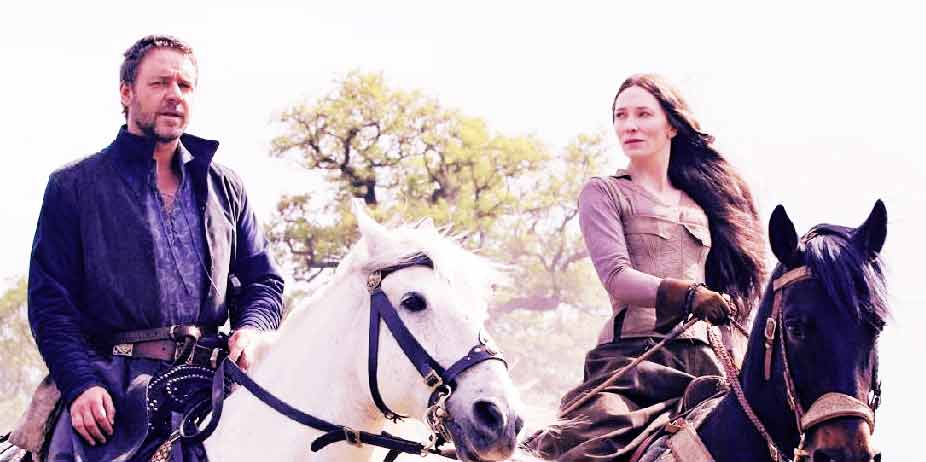
With most of the men in Nottingham off to war on the Crusades with Richard "the Lion Heart," their wives and daughters are left to fend for themselves in near-poverty. In the ten years since her husband's departure, Lady Marion (Cate Blanchett) has managed to see her tenants taken care of, in spite of five seasons of lean gathering and oppression both from the government's need for taxes, and the interference of the Church, who requires a large donation annually from the parish. Her husband Robin Loxley meanwhile is making the final push through France with Richard, in the hope of soon returning home. But the French are unwilling to go down without a fight and the monarchy summons an English assassin with ties to their court to put an end to Richard's life. Godfrey (Mark Strong) is well trusted by Richard's younger brother Prince John (Oscar Isaac), and it is believed he can sway John toward unpopular policies, which will divide England and ultimately cause it to fall to foreign invasion.
Caught up in the midst of it all is Robin Longstride (Russell Crowe), a notable archer who is tired of war and simply wants to return across the channel. When Richard is killed in combat, Robin comes across the assassin and his party and makes a promise to Loxley that he will return Loxley's sword to his father, and tell him of his noble death. Knowing he will not be permitted to travel safely unless he is a knight, Robin and his friends borrow identities and reach the shores of England, where he presents the crown to Eleanor of Aquitaine (Eileen Atkins). Determined to keep his word, Robin then travels to Nottingham, not realizing that this decision will impact the course of his life forever...
The critics are panning this and I am not altogether certain why, because it certainly is epic on every level. The director knows his craft in creating sweeping, romantic and often brutal cinematic experiences and this is no different from most of his costume drama projects in that it is glorious to look at, with gorgeous cinematography and excellent performances. Cate and Russell have immediate tension and chemistry, and their romance as it unfolds is both fun to watch and crackles with the promise of future passion. The two bicker and banter and exchange lingering glances and when they finally get around to their first kiss, it is as meaningful as it is tender. The supporting cast is notable as well, with an alternately irritating and likable King John -- at times, we almost feel sorry for him, and then he does something unforgivably pathetic and we retreat into hating him once again. The most glorious villain is Mark Strong, who snarls and grins his way through his scenes, burning houses to the ground, slaughtering anyone who crosses his path, and even stabbing an old blind man through the heart. If that's not a bad guy you can root against, I don't know what is.
I suppose some amount of complaining could be launched in the direction this film took, in establishing that Robin is not who other films says he is, but since I have never particularly liked any of the goofier representations of the character, I for one am not complaining over a massive re-envisioning. If you go into it knowing this is not your traditional Robin Hood, I think you will find it engaging. True, the beginning does jump around a bit in establishing all the different characters and happenings in two separate nations, and Richard is not all that likable, but once Robin arrives in England the pace picks up and Scott's talent as a director gleams particularly in the last half. I liked the nuances of the characters; Robin is of course likable, but Friar Tuck now raises bees (and gleefully sets them on some French soldiers at one point), Little John has a bit of a temper, and Marion has been transformed from a damsel in distress to a feminist icon who can more than look out for herself. There are little moments and instances of humor, but for the most part it is a serious drama.
The rating never pushes it in my opinion but does caution audiences not to take children, and I agree, this is no place for young ones due to the extreme level of violence involved. Most of it isn't gruesome (the most disgusting shot is a man shown with an arrow sticking through his neck) but there is an immense amount of mortal combat; hundreds of men are shot with arrows, stabbed with swords, struck from their horses, or thrown to the ground. The tide turns red from blood being spilled; it drips from minor wounds. One character's face is sliced with an arrow. From the presence of three women stumbling out of a hut in the morning, it's implied Robin's friends have spent the night fornicating. Marion shares her bedchamber with him (he sleeps on the floor) and threatens to cut his manhood off if he so much as lifts a finger to touch her. Twice, men make advances toward her; in the first, she bites his lip when he attempts to kiss her, and in the second she stabs him with a knife hidden in her boot. The most unsettling scene finds John in bed with his mistress; his mother storms in, rips the covers off (they are still covered, but he's on top), and tells him off. It's implied he reveals himself to her when he stands up -- the camera barely avoids showing us too much (we do see a blurry bit of upper leg). There are a couple of minor innuendos. Christ's name is used several times, and Marion calls a bunch of thieves "little b*stards." There is quite a bit of drinking.
Religious references are limited to a couple of comments about the corruption of the Church during that time period (being ambitious and greedy, at the expense of the peasants). Friar Tuck becomes interested in assisting Robin in ripping off a Bishop once Robin threatens to tell Tuck's superiors that he is making money off selling honey mead. Robin makes a reference to a particularly "godless" slaughter scene during the Crusades. Marion, however, says that she prays regularly for miracles and it could be construed as an answer to prayer when it begins to rain after planting a field. Minor deceptions are involved on several fronts, along with some expected thieving. All in all, it's not what you might expect from the tale but is a re-imagining that left me with a smile on my face. It's fun once in awhile to just sit in a theater seat and enjoy the experience, and that ultimately is what can be said of Robin Hood: a few blatant historical inaccuracies aside, it is not meant to be taken too seriously, and in that regard it's just what I love most: a rousing adventure.