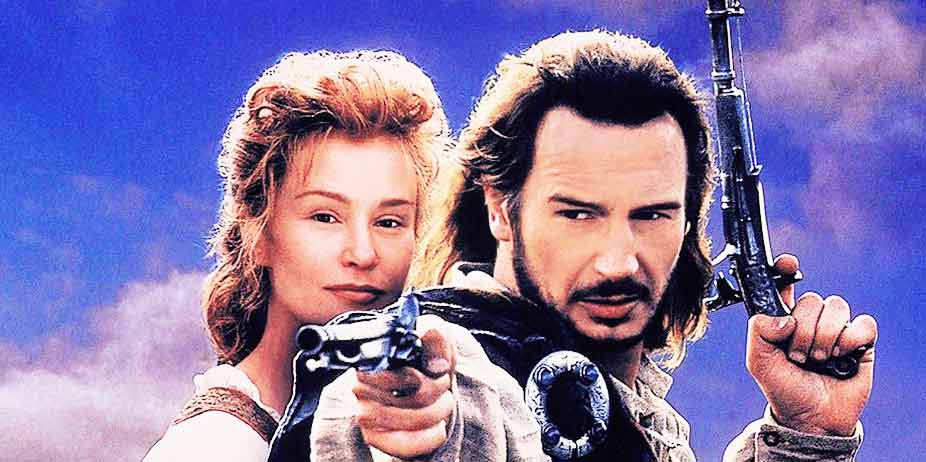
Rob Roy (1995)
One of my friends warned me never to rent Rob Roy. By the conclusion of the film, I was wishing I had listened to her.
The Scottish Highlands are ruled over by a succession of wealthy European monarchs, marquises and barons from England. The local landowner's cattle have been thieved and a gathering of his tenants, lead by the legendary Robert McGregor (Liam Neeson), nicknamed "Rob Roy" among his friends, have set out to reclaim them. Killing the ringleader of the rustlers but allowing the rest to go free with a warning, he returns the property to a grateful marquis. His wife Mary (Jessica Lange) welcomes him home, grateful that he has returned unscathed. The Marquis (John Hurt) has brought a new fighter in among his consort, a womanizing, foppish swordsman by the name of Archibald Cunningham (Tim Roth) who is financially impaired and content to play the master's fool, while bedding his kitchen maids.
Believing that cattle are the way of the future, Rob decides to make an investment. An agreement is made with the marquis as to the lending of a thousand pounds, to be paid off with interest. The McGregor property is put up as collateral, with the entire village hoping to benefit from the proceeds. This garners the interest of the marquis' greedy and scurrilous attorney, Killearn (Brian Cox), who persuades Cunningham to help him thieve the money. Tracking down and murdering the trusted courier in cold blood, the two men allow Rob to bear the brunt of punishment. Believing that the courier has run off to the Americas with his fortune, the marquis demands to be repaid. When Rob refuses his attempts at blackmail to incriminate another local baronet in treachery against the king, he must turn rogue to avoid being hunted down like a dog. Cunningham is unleashed upon the countryside, free to brutalize the men of the village, rape their women, and burn local properties.
The consequences of these actions will have a mighty backlash among the innocents drawn between two equally powerful and determined men. While Rob Roy is done with masterful storytelling and has a compelling conclusion, I found it to be far too disconcerting to be considered quality entertainment. The costuming and casting is perfect, and all the actors are absolutely remarkable in their roles. Tim Roth plays a notoriously unscrupulous villain, cold and calculating, downright cruel to those who fall beneath his command, who is strangely empathetic toward the beginning. Liam Neeson is an excellent offset to his sneering charm, maintaining dignity despite his hardships. Minor characters were well chosen, and the dialogue they delivers has a degree of authenticity. However, I question why it had to be so sexually oriented. The film is inundated with such vile depictions of perversion that I cannot tell you the worst of it, except there is more than one instance of a hand going up a skirt (in one instance, she is unwilling but forced), numerous blunt conversations about sexual acts, partial nudity, and two scenes of graphic lovemaking between a man and wife (fully clothed). In the film's most disturbing scene, Mary is bent over a table and raped by Cunningham. The scene is extremely long and brutal, and is referenced numerous times through coarse innuendo, Cunningham taunting her husband, and the discovery of her pregnancy. I had never seen anything so horrible. There is language (mostly Scottish slang), and gory violence. Men are shot and stabbed, with gruesome results. Primitive abortion is referenced twice. Mary confesses that she cannot kill the baby, and Cunningham tells his mistress to terminate her pregnancy.
Family plays an important role in the tale and the issue of honor is upheld. Rob Roy sacrifices everything so that he will not "bear false witness" against an innocent man. He looks after the men of the village and acts in the interest of justice more than revenge. He is willing to accept Cunningham's child into the love of their home. But these feeble virtues were overshadowed in a gross depiction of perverse sexuality. It seemed as though it was a constant topic. I did not object to the central pivot of the plot as much as how they were depicted, with entirely too much realism. Any woman would find this impossible to watch, and any man should be equally disgusted.