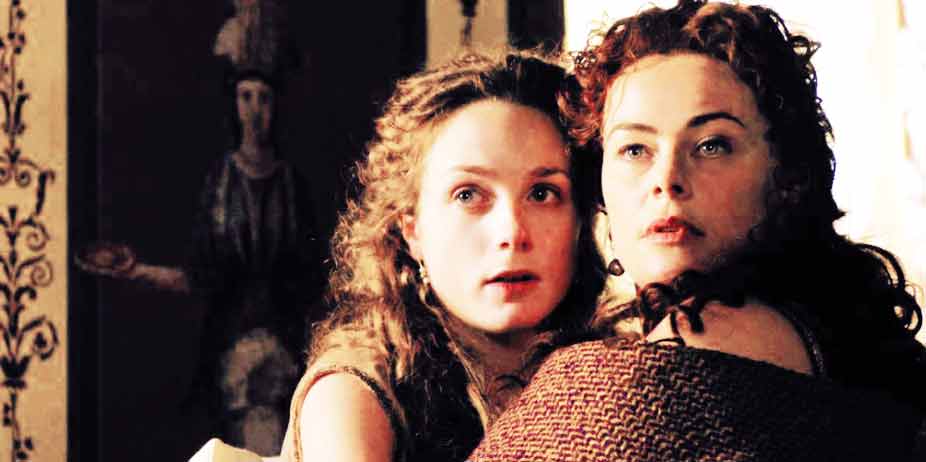
Rome, Season One (2005)
Given my fascination with Julius Caesar, it was inevitable I should watch Rome, but fortunately I had friends to warn me about the level of content first. It's one of the most powerful historical dramas I have seen, but also the most sexually revolting.
The 13th Battalion of the Roman Guard has been stationed in Gaul to put an end to an uprising. Lead by the charismatic and battle-wise Julius Caesar (Ciarán Hinds), it has managed to triumph over its enemies and bring about a temporary peace. But the Roman Standard has been stolen and two men are chosen to find and restore it to the camp, in order to lift morale among their troops. The two men are Lucius Vorenus (Kevin McKidd), a centurion longing for his wife and family at home, and Titus Pullo (Ray Stevenson), a free spirit only concerned with surviving battle, bedding beautiful maidens, and drinking himself to an oblivion in taverns. There is an immediate kinship between them that makes them a formidable duo, and they return triumphant not only with the stolen standard but the news that it was not taken by members of the enemy guard but an associate of Caesar's former friend and supporter in Rome, Pompey.
Resentful of the incredible popularity Caesar has obtained abroad, Pompey (Kenneth Cranham) slowly becomes convinced that his friend is dangerous. Rome is in the midst of uncertainty as Caesar intends to return triumphant and confront his enemies, placing his friends and family into dangerous positions. His scheming niece Atia (Polly Walker) intends to retain power no matter what the cost, even if it means offering her daughter Octavia (Kerry Condon) to Pompaii as a new bride. Little does she realize that her son, the cunning Octavian (Max Pirkis), is far more dangerous. There are many more characters than mentioned here -- from Brutus and Mark Anthony, to Lucius' wife and daughters, as well as a slave girl Pullo rescues, Julius Caesar's mistress and her household, and of course various members of the Roman and Egyptian courts (Cleopatra, Cicero, etc).
It is an incredibly detailed and complicated twelve episode series that has a huge scope and even bigger following. It's one of the most accurate series I have seen depicting the depravity and horrors of the time, isn't difficult to follow, and never dull. The acting is quite good but the plot suffers from extremely unlikable characters. There is no one to root for, since everyone is so flawed that I could not like any of them. For example, just as I was starting to come around to Pullo's virtues, in a jealous rage over a woman, he bashed a man's head open against a column and killed him. I liked Caesar's mistress... before she set out to seduce a young woman and manipulate her into destroying her family from within. The only character I liked was Caesar but we all know what happens to him in the end!
The way the writers have woven lower class individuals into the story along with historical figures is nothing less than remarkable. The characters of Pullo and Lucius are even based on real life Roman soldiers; nothing is known about them except they were as "close as brothers, and would risk their lives for one another." The costume design is beautiful, the scope is tremendous, and the acting is excellent, but the content is beyond graphic and borderline pornography. Its themes are unpleasant and the violence is gut-wrenching. I was so distracted by it I couldn't get emotionally involved, and this meant none of the characters left a lingering impression. I didn't even cry when Caesar met his end, and that's never happened before. Some might argue that in the authenticity of showing the period as it was, Rome doesn't go too but I differ. There are ways to insinuate things or show the debauchery of the period without forcing the audience to witness things they would never stand around and watch in real life.
Sexual Content:
Full frontal nudity on men and women, numerous times. Crude sexualized sketches on the walls of Rome. A dozen graphic sex scenes that leave nothing to the imagination, including a homosexual love affair. Incest.
Language:
Several dozen f-words, along with innuendo and sexual conversations.
Violence:
Pullo is forced to fight for his life in the arena. His slaughter of gladiators is gruesome -- heads and limbs go flying off, and blood pours onto the ground. Throughout, men are impaled. Knives stab people through the throat. Caesar's death is brutal and difficult to watch; blood soaks his toga and those of his attackers as he falls to the ground and lays there, twitching, until Brutus finishes him off. Caesar strikes his mistress until she falls to the floor, and Mark Anthony viciously slaps Atia across the face.