 The
Scarlet Pimpernel (1999)
The
Scarlet Pimpernel (1999)
The Hungarian baroness and creator of one of the most immortal characters in English literature must be rolling in her grave. Some idiot at A&E has taken the Scarlet Pimpernel and turned him into a heartless wit, a teller of improper jokes, and often a fool; they've done abominable things to Marguerite's past, turned Chauvelin into an immoral prude, and put to death one of the League. Sink me, sir, it's an outrage! If you love the books, keep away from this adaptation. Otherwise, you might have the courage to put up with it... but never base your like or dislike for Percy and his League on this shameful gathering of illusive players set against the violent backdrop of the French Revolution.
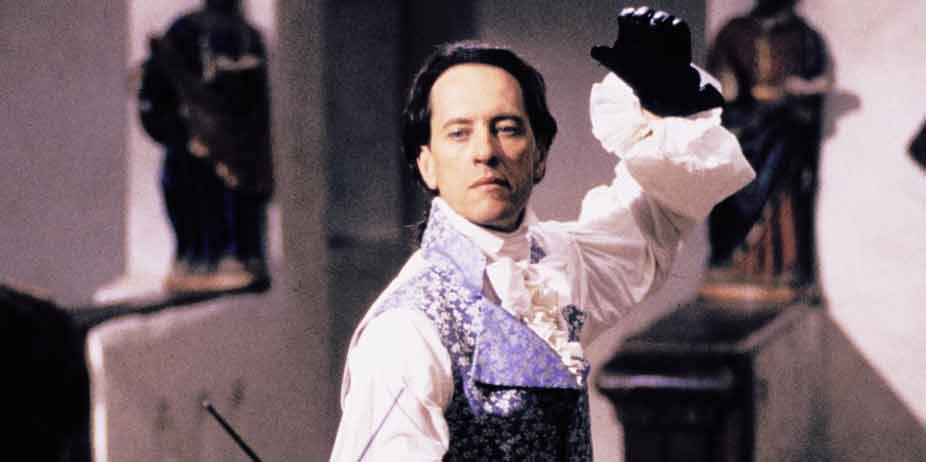
It's the height of the new order in France. Robspierre rules with an iron fist, and hundreds upon hundreds of innocent aristocrats are put to the guillotine by day. Only one stands against them... a mysterious individual able to whisk regal necks away from the bloodstained blade into England in the dead of night. To the French, it's an outrage. In England he's a hero... although no one knows just who he is! At the center of controversy lies Citizen Chauvelin (Martin Shaw), one of Robspierre's officials who is commissioned to find the rouge... or lose his head. Chauvelin travels into England in the hopes of learning from the British monarchy's own lips the secrets which will lead him to the Pimpernel. Marguerite (Elizabeth McGovern), formerly a French actress, is the wife of one of England's most notorious wits, Sir Percy Blakeney (Richard E. Grant). A former lover of Chauvelin, she is horrified when he travels to London and attempts to enlist her aid in revealing the Pimpernel's identity. But Chauvelin has foreseen her reluctance, and holds a bartering tool... the life of her brother, Armand, who has been arrested in Paris for crimes against the government. If she gives him the Scarlet Pimpernel, he will return Armand. If not, her brother's life will be forfeit.
Little does Marguerite know that her husband is the Pimpernel! He has heeded the advice of one of his League, who was captured and tortured to death in Paris... "Do NOT trust her!" and kept his identity masked. He takes Marguerite's plea for her brother's life with callous flair and sets off for Paris along with his friends Anthony and Andrew in a rescue mission. Unfortunately, Marguerite has given Chauvelin a valuable piece of information which will compromise the mission... and even Chauvelin doesn't fail to have a few tricks up his sleeve. Full of twists, turns, surprising character revelations, and a good deal of swashbuckling adventure, The Scarlet Pimpernel is a fine story... but not the one its author intended. Her characters have undergone a complete transformation, often for the worse. Chauvelin has turned into a fiend with a string of girls in his bed. Percy has become cold and cynical even to the point of swiftly overcoming his horror of having one of his men executed. Tony has become a dupe, an overly innocent, stuttering fool. And Marguerite? Well, let's just say this isn't the Marguerite I grew to know and love.
This film series doesn't fail utterly in several respects... Richard E. Grant is a wonderful Percy -- if only he'd been given a little more to work with! His self-satisfied sneers, the twinkle in his eye as he's about to deliver some great wit, and the look of mischief on his face as he outruns Chauvelin and then produces to steal the man's own horse to ride away on, is wonderful. His scenes with Elizabeth McGovern as Marguerite are properly intense and often romantic. But the humanity in him is missing. The Percy I know would have been utterly distraught at having lost one of his men. I also sincerely doubt he would kill as recklessly as this Pimpernel does. But his scenes in the English court, and in particular one in the French prison when he takes apart his cloak, cravat, and even boots to reveal a set of lock picks and other useful objects, almost make up for the flaws... of which there are many. Overlooking all the inconsistencies with the books, and some of the truly absurd things the writers do with our beloved characters, this first installment in the Pimpernel series is full of bawdy humor, immorality, and occasional violence. A badly beaten man is mottled with bruises and leaves a trail of blood on the prison floor as he's dragged away. (Chauvelin implies that he's had his toenails ripped out as part of his torture.) A bloody blade is shown as people are lead to the guillotine. People are shot and killed; a riot erupts and prisoners are beaten to death. Percy duels with soldiers in a stairwell, and winds up stabbing most of them. A woman is found with blood on her shoulder, apparently from a slit neck. A man is shot in the head, with mildly bloody results. Many people are shot and killed. There are implied executions in the town square. We see one man being lead up to the guillotine before the blade falls; then we hear the blade falling several times more while a priest cowers in a darkened room. Several people are slapped violently. Percy and Lord Andrew have to fight their way through a guarded abbey to find Marguerite; they stab some guards. The nuns are all found murdered. A man is knifed in the chest. Profanity includes Percy's favorite terms ('Lud,' and 'demned') as well as some common profanity and mild abuse of deity (including b*tch and whore). Madam Guillotine calls the abbey a brothel, throws a Bible to the floor, and orders the nuns to be executed. A man's neck is twisted, swiftly killing him. A woman is slapped violently as Louis is kidnapped. A body is found in a vat of water; a brief examination proves she too had her neck broken. A figure is found hanging from the ceiling (only his legs are shown). In a violent duel, a man is cut several times. His opponent is finally stabbed (off-camera and with no blood). Several people are hit over the head.
Dialogue intimates the soldiers often enjoy raping female prisoners. Innuendo intrudes on a regular basis... from the polished marble floors of the English court to a French courtroom. Too bad this isn't as far as the sexual content goes. Marguerite's brother is shown rolling around in bed with an actress early on in the first film; they're interrupted by soldiers come to arrest him. Later the same woman is seen in Chauvelin's bed, bare-shouldered and obviously flirting with her lover's manservant. Percy and his friends visit the home of a French painter who has some immodest paintings on display in the background. They visit him again during a party in which some immodest dancing intrudes; Tony is dragged off by three girls, who pour water over his head and undress him (his bare backside is briefly seen). Percy merely smiles and makes a joke. The last scene has our lovely couple kissing and giggling in bed as the camera pans out. Marguerite teases her husband verbally while on board ship, sliding her hand beneath the covers and lamenting on the 'rocking of the boat.' Eventually he gives in and kisses her passionately before the scene fades out. One of Madam Guillotine's soldiers spies on her through a keyhole as she bathes (nothing but her arms are seen). The worst flaw comes when Percy, under the guise of Chauvelin, appears to try and seduce her. He goes a little too far. I wouldn't have minded some romantic banter, even some mild flirting, but cornering her on the divan, opening her blouse, and kissing her cleavage is surprisingly out of character for the Pimpernel. As he wrestles her to the floor, stuffs a gag in her mouth, and ties her up, her muffled shrieks set the guards to snickering, certain that something sexual is going on.
The three-film series has its on and off moments of brilliance, but the aggressive sexual content make it a rocky ride, particularly when you're unable to distinguish A&E's ideal of Percy from that of his author. My suggestion would be to read the books, and if you must see a film, borrow the Anthony Andrews version. It covers all this ground and far more in a much more pleasing and moral format.