 Schindler's
List (1993)
Schindler's
List (1993)
Something of a reluctant hero to begin with, Oskar Schindler was a German profiteer during WWII's invasion of Poland. Stephen Spielberg filmed this movie without salary and despite studio protests in order to pay homage to what happened to millions of Jews during the Holocaust. The result is a thought-provoking film horrible in the most personal kind of way. It shows us blatant cruelty and terror up close yet manages to also convey internal struggle in the primary characters, who are equally flawed yet intensely charismatic. It's certainly not for the faint of heart and is like no other movie ever made. It's not as gruesome as The Passion but that doesn't matter... Schindler's List will stay with you for a long time.
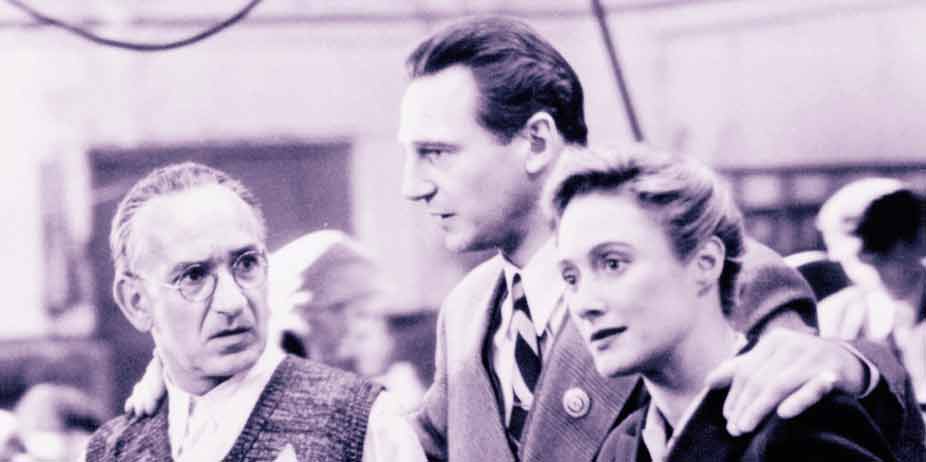
Nazis have just invaded Poland. Oskar Schindler (Liam Neeson) is a wealthy German looking for investors to begin a metal manufacturing plant. He wastes little time in befriending high ranking German officials, mostly of a military nature, but goes to the already oppressed Jews for finances. Among those working in the local relief office is Itzhak Stern (Ben Kingsley), an accountant whom Schindler hires to help get his industry off the ground. Stern brings together the wealthiest Jews from the Ghetto and they strike a bargain. They will give him millions to start the company, and he will pay them back in tradable items. Money is worth nothing inside Ghetto walls, but illegal trade is booming. They meet wherever they can, and those who work outside the walls have special privileges. Jews have been turned out of their homes, streets, and synagogues. Schindler has taken up residence not far from the Ghetto. He can work Jews cheaply in his factory, and through military contracts for crockery, hinges, and other metal necessities, can build a fortune.
Around him, Poland is starting to unravel. He must rescue Stern from a liquidation train bound for a gas camp. His workers are removed to shovel snow for incoming army transports. One of them is shot in the head simply for being one-armed. Stern seems to be using his plant as a hideaway for the Jews most likely to be terminated. Old men, very young children, those with birth defects. Schindler is enraged because it slows his money-making industry, but as the war progresses begins to feel stronger empathy for his workers. He watches as the Ghetto is forcefully liquidated. Jews are lined up and shot. They're herded off into other camps, beneath the tyrannical, cruel hand of Amon Goeth (an overweight Ralph Fiennes). He likes to shoot prisoners randomly from the balcony of his villa overlooking the camp. He's chosen a young Jewish girl (Embeth Davidtz) to act as a housemaid; she fears for her life. Schindler makes a friend of Amon and uses his influence to bring more empathy to the camps. But there is an end to what influence he can wield, particularly when Germany begins to fear it may lose the war.
Schindler's List is more than merely a brutal glimpse at the horrors inflicted upon the chosen race. It's also the story of one man's transformation from money-hungry businessman to humanitarian. Schindler begins with very little empathy or interest in the Jews beyond what finances they can build for him, but by the end has sacrificed a great deal to become their liberator. He doesn't smuggle them out by the hundreds but instead gives them work in his factories. Because they're producing military-related items, they are not so rapidly "liquidated." The ammo shells they produce are purposefully defective. He gives his entire fortune to "buy" them from the gas chambers, and still feels wracking remorse that he couldn't get "Just one more!" Stern plays a large part in forcing Schindler's hand. He rapidly erases all Schindler's preconceived notions toward the German army. He deliberately places Jews in need of assistance into the man's way. He acts as his conscience on many levels. This is the true heart of the movie, beyond the horrors of seeing children loaded onto transports and the streets bathed in ash from the furnaces. The performances are powerful, the setting is powerful, the story is powerful. Ralph Fiennes and Liam Neeson were both rightly nominated for Oscars.
The atmosphere of the film is very dark and moody. It was filmed in black and white so color would not detract from performances, but perhaps also to avoid being too gory on such a personal subject for the director. If it was in color, the film would be much more difficult to take. There are numerous scenes and implications of violence. Men and women are shot at point-blank range, often spurting blood on the ground and passerby. Bloodstains eek into the snow beneath fallen bodies, and bathe the streets. Soldiers conceal themselves in the Ghetto to await darkness, when all who have hidden will come out. Then they rush up to slaughter them -- we hear the constant fire of machine guns, the reflective light bouncing off the walls while a single soldier plays Mozart on a Jewish piano. Nazis choose their victims randomly. The man without an arm. Every other person in a lineup. Someone slower, thinner, fatter, or darker than the others. Amon picks them off from his balcony. He gives one boy freedom after failing a task and we see the child dead in the next shot. Tempted by Helen, his Jewish servant, Amon becomes angry and beats her. We see him throwing her around the room, punching her in the face, and finally overturning a cabinet on her.
Violence is forgivable in this kind of a film, since in order to get emotional impact you have to show what it was like -- terrible. But the nudity and sexual content is gratuitous and could have been avoided. Schindler was an avid womanizer and entertains many pretty girls. He's shown engaged in fairly graphic sex with one of them. The woman is naked and we see her bare breasts. Another bare-breasted woman is seen in his room toward the end of the film. Helen has just come out of a bath when Amon comes downstairs. You can make out the outline of her breasts through the partially-sheer garment she's wearing. While he shoots Jews from his balcony, one of his many girlfriends lays on the bed topless. We see her breasts in several shots; in the same sequence, we see him urinate (no nudity) in the bathroom. Prisoners are ordered to strip and run around in a circle so "doctors" can pick out the worthless ones. There's male and female full nudity in these scenes, as well as later when the girls are forced into German "showers." Editing companies remove these flaws and it doesn't lessen the emotional impact of the film.
There is also quite a bit of foul language. Amon uses the f-word regularly (about nine times), there are two abuses of Christ's name, and mild deity. It's not the strip scenes or random slaughter that gives us the greatest feeling of repulsion and horror. It's the small things. The little girl with the red coat. Soldiers reassuring the Jews their luggage will be transported, then taking it into a building and dumping it in piles to be sorted and sold. The bin full of pictures... precious images to those going into the camps, now random, scattered photographs whose histories will never be known. The children being thrown into army transports; others hiding in terrible places around the base. Inside chimneys, beneath floorboards, even in the latrines. Dead bodies being exhumed and burned. Portrayal of the Nazis is incredible; how could mankind ever do this to anyone? Just to walk up and shoot them for fun? To take pleasure in their misery? How could the rest of the world look away for so long while hundreds of thousands of people were being abused and murdered? You feel like Schindler... powerless to do anything, yet determined to show compassion and kindness. He offers empathy to Helen when she's the most terrified. He convinces Amon "as a joke" to hose off the train cars, giving the hot, cramped occupants some relief. He steps in when the army wants to take children away from their parents.
It's a powerful movie that reminds us of the nature of evil, and should be watched by everyone at least once, when they're fully prepared for the emotional consequences.