 Small
Island (2009)
Small
Island (2009)
Recently, the BBC has shown an interest in producing more costume dramas centered during and after the second World War. Small Island is one of their first ventures into the genre, adapted from a bestselling novel.
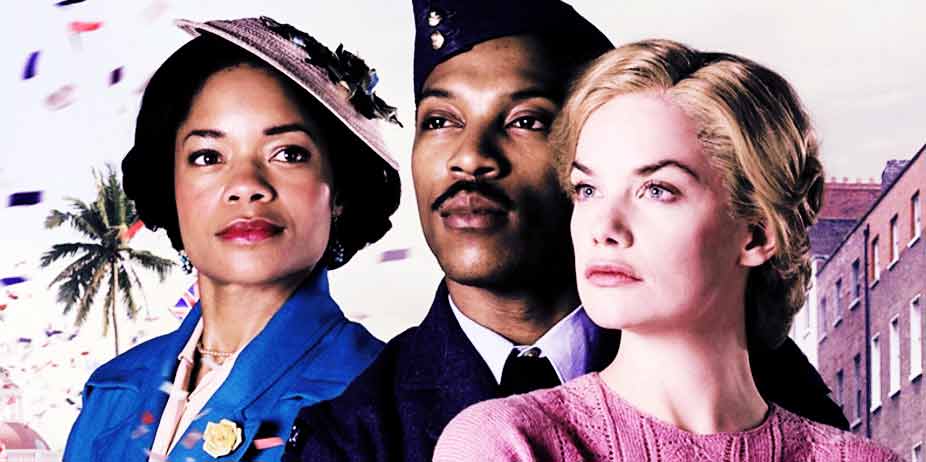
Life in the wilds of Jamaica is hampering for those of ambition after the war has ended, and many of the locals show an interest in migrating to England. Their dreams are of big houses and plenty of work, of afternoon tea and being thought of as equal among their neighbors. Hortense (Naomi Harris) intends to be a school teacher with a fine house, but she cannot go alone. So when a local young man named Gilbert (David Oyelowo) expresses his desire to move abroad but laments his lack of funds, she agrees to pay his way if he will marry her and send for her once he is settled. It is a marriage of convenience that generates all the wrong kinds of sparks -- Gilbert is practical and passionate, Hortense is haughty and proud. Her heart truly belongs to the boy she was raised beside, Michael (Ashley Walters), but he has been lost in the war. Or so she believed... what she does not know is that he made his way to England instead.
Prior to the war, Queenie (Ruth Wilson) had no great ambitions toward marriage but when the mild-mannered Bernard (Benedict Cumberbatch) offers her a home and security in the midst of such uncertain times, she consents to become his wife. During his service to his country, he goes missing and Queenie is forced to lent out their upper rooms to make the rent. Her first stay-in is Michael, for whom she develops a fondness that will change her life, and the lives of Hortense and Gilbert, forever. Admittedly, I did not much care for this film in the first hour or so, although it is enjoyable to see a different angle on the war for once. The miniseries has been especially well received among Jamaican immigrants and is also an intelligent, interesting look into an aspect of story not often told about European racism during the 1940's. The characters are all fully human in the sense that we become fond of some and distrustful of others, but most of them go through some significant change that makes them better individuals for it. Hortense in particular loses some of her arrogance and warms up to her husband, while Queenie makes a deeply sad decision involving self-sacrifice, and Bernard takes dramatic steps to overcome his racism. The most likable character is Gilbert, but even he is not perfect.
The costumes and sets are all beautifully authentic, and we also get to see portions of Jamaica and what life was like there before and after the war. It's a well-written script but one of my complaints is that at first it is difficult to follow since there are flashbacks to the past contained within the story; if one is not paying attention it is easy to become temporarily lost. These transitions become easier as the tale progresses and soon we stop noticing them altogether as the pieces fall into place to form the entire story. Having said that, there are a few things I disliked about it -- Queenie winds up in an adulterous affair with Michael, who appears to be something of a libertine. She falls in love with him but he is interested in her for other reasons. This aspect is important to the outcome and happenings that transpire as the story unravels, but I felt could have been handled more discreetly. There are two "love scenes," one involving near-nudity, gentle kissing, groping, movement, and elated facial expressions; the other contains more movement and is a little more "violent." Implications would have been enough, in my opinion, and so it taints what otherwise is an intriguing story.
Scattered profanities are found here and there but the worst of it is one f-word and a use of GD. Racial terms and slurs (such as the n-word) are thrown around by white soldiers. Violence involves several scuffles, one of them becoming brutal in the street in which a black man is beaten up by a gang. The police arrive and shoot into the air, killing an innocent bystander. There is a birthing scene (non-graphic). Hortense screams when her husband removes his clothes on his wedding night and intimates he'd like to share the bed with her, but the camera sees nothing below the waist. (He winds up sleeping on the floor.) Michael is depicted as having had an affair with a married woman, whose husband is a local minister in Jamaica. A man mentions having visited a brothel when drunk and shows concern over whether or not he may have syphilis. Christianity is not cast in a very good light, since Hortense's caregiver is a hot-tempered, insulting man prone to demanding his own way.
In conclusion, I liked the turn it took in the second half when Bernard returned home and was forced to contend with the consequences of his wife's affair. Their marriage started out platonic (on her part) and winds up in a place where she begins to see his merit and respect him as a good man (although he does make some mistakes, including at first showing obvious racism). One of the best scenes is him warming up to a little black baby. I was interested in these characters and their lives. Overall, it was a decent enough way to spend three hours, and I admire them for finding original material, but it's not a miniseries I feel compelled to own.