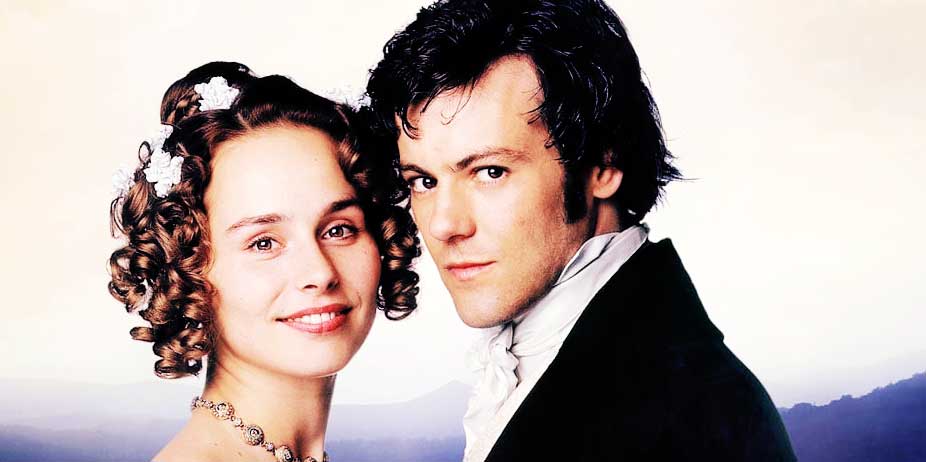
Tenant of Wildfell Hall (1996)
A lot of period films run along the same lines: angry, abusive husband, ill-treated, frightened wife. Yet the audience never seems to tire of it. The Tenant of Wildfell Hall is the "controversial" novel by Anne Bronte, the lesser-known of the three Bronte sisters (Charlotte and Emily wrote Jane Eyre and Wuthering Heights respectively). It carries much the same dark flavor but hopeful ending as her sister's works. This adaptation is interesting by its own right, but not particularly memorable.
A candle is lit in the darkness. Swiftly a woman dresses. A hand is lain over a child's mouth, quieting him as she whisks him downstairs. In the eerie early hours of dawn this figure and her son flee out an impressive wrought-iron gate and into a waiting carriage. They are the new tenants of Wildfell Hall on the downs. Helen Graham (Tara Fitzgerald) is little known to her neighbors; a secretive woman who just wants to be left alone. She paints very well, her only means of support. Her son Arthur is a darling little boy, but overly guarded by his anxious mother. The pair interest the villages, most particularly Gilbert Markham, a yeomen farmer courting the minister's daughter. Secrecy does not bide good intentions and soon rumors are gravitating around Mrs. Graham.
A distinguished member of the parish has been seen visiting her at strange hours... his horse is witnessed tied up outside the house at night, yet when in company the pair never even acknowledge one another. Vicious rumors of their adulterous involvement are centered around how strangely young Arthur reflects the man's countenance. Gilbert (Toby Stephens), who has fallen in love with Helen, is enraged by these accusations. Knowing his emotional involvement, Helen offers him the opportunity to know her past in its entirety. Given a small diary of her innermost thoughts, Gilbert finds himself discovering the true reasons why Helen wants to be alone, why she protects her son overtly, even why the man sometimes comes at night. It involves an adulterous, abusive husband, wretched family acquaintances, and the bitter strains of scandal. Helen was married young to a society rake, who changed over the years into an impossible drunkard with a determination to turn her son against her and justify his own illicit affairs. After two horrible events in her life, she sought protection from his wrath and became the mysterious Tenant of Wildfell Hall.
I've grown fairly used to these types of adaptations, which often have a melancholy tone and reveal piece by piece the truth. In as much, it's not an entirely worthless piece of filmmaking. Tara Fitzgerald makes a likable Helen despite the horrible hairstyle and shrewd dialogue. Tobey Stephens is an excellent Gilbert, with just enough passion to be likable while yet remaining restrained. Rupert Graves I have yet to see play anyone moral, but he does well as the unfaithful husband. Visually the film is very dated, and the director has chosen to use extreme close-ups, strange overhead shots, and other visuals which detract from the film rather than add to it. The content is present but not overly graphic yet it's threaded throughout the film carefully so you can't merely clear one major content hurtle and be done with it. The sexual content never gets overly graphic but much of it is sensual and lengthy.
Helen's husband Huntington unlaces her gown and kisses his way up her body (nothing explicit); they're then shown bare-shouldered cuddling in bed. On another occasion he wakes her up after an argument, turns her over, and lays on top of her. In a fling with another man's wife, Huntington pushes her up against the wall and pulls up her skirt. In a violent rage, he forces his wife to the floor with the intention to rape her but thinks better of it. He's also the only period French kisser I've ever seen. Language is mild except one use of GD. Violence consists of bird-shooting and a man taking after someone with a horse whip. Huntington takes his six year old bird shooting and wipes the blood of a pheasant on the boy's face for shock effect. This encourages the child to go into the house and strangle one of his mother's birds (implied). The camera gives us an eerie close up of him waving the dead bird around (both in a flashback and actual event). Later he shows similar cruelty to a grackle, and his violently shaken for it. Some mildly sensual dialogue crops up. Huntington forces his little boy to consume alcohol on two occasions. Later he suffers from consumption and is shown coughing up blood.
The ending is a satisfactory one, but getting there has its rough patches. Troubling implied sexual content and cruelty make The Tenant of Wildfell Hall a dark and despairing adaptation. I didn't hate it, but nor did I particularly enjoy it. It all comes down to a matter of taste, and my tastes lie more in inspirational stories rather than gothic melodrama.