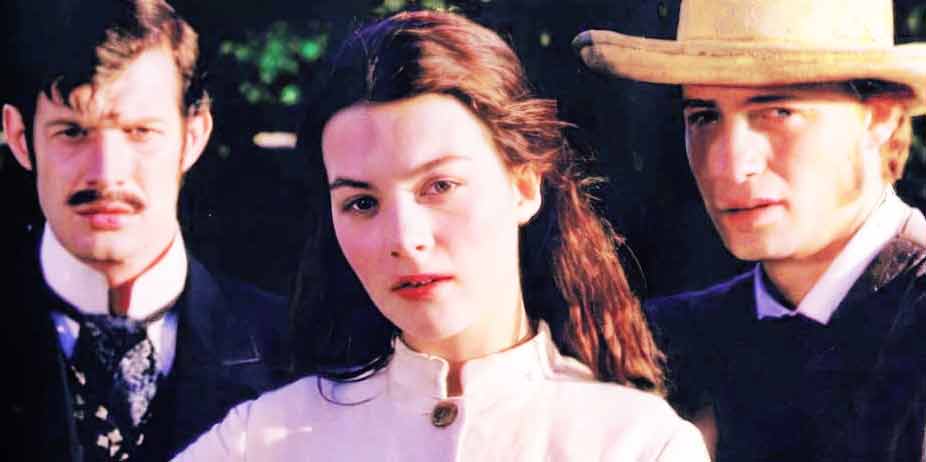
Tess of the D'Urbervilles (1998)
This artful television miniseries captures the essence of sheltered life and the tainted world in which it is set, and in doing so becomes a moral paradox that the viewer is left to digest. The impoverished D'Urbervilles have just learned that they may be a lost limb in the root of a deep-set and wealthy family tree that has governed the county since the early years of the country's beginnings. Eager to patch alliances between their financially-secure cousins and perhaps gain some security in their own humble position, the D'Urbervilles send their eldest daughter Tess (Justine Waddell) to make the alliance. And thus fate is set in motion, providing a rich but sadly tragic backdrop for the story of a woman's struggle against the odds.
Naive Tess senses nothing in the ardent attentions of her handsome cousin Alec (Jason Flemyng) and soon finds herself at home in the comfortable surroundings of a society high above her own. The pair share several fascinating adventures, from the wild carriage ride pell-mell down the hill above the manor to the gentle lesson in which Alec teaches her to whistle to his mother's birds. "I have taught you to whistle, cousin," he says ominously. "One day I shall teach you how to kiss." With those fatal words, the film enters a darker stage upon which the next several hours are set and one night Alec overpowers her in the wood. Dejected, angry and abused, Tess returns home bearing his child, refusing all offer of help or compensation for her misuse, and undertakes a life scorned by her fellow practitioners; even the pastor refuses to baptize the illegitimate child or give it a proper burial when the child is taken by a sudden illness.
Attempting to flee her past life, Tess takes a position as a dairy maid in the next county and there sparks the eye of Angel Claire (Oliver Milburn), the son of a clergyman. Wary of the ways of men, Tess attempts to dissuade his attentions, but love is impartial and overpowering and she finds herself falling beneath his gentle spell. Angel believes her to be the very existence of goodness and purity; although her forgiveness of his past sins is evident, things take a tragic turn when the past is brought to light and he spurns her on their wedding night. Her life has been a never-ending unfolding of personal tragedy and inevitable questioning of the laws of nature. But now, faced with a love that is scarred by prejudice, Tess again faces her highest challenge. Her overcoming and inner strength carries her through without condemnation, and overall the film is a good one in the lessons that it teaches. A&E did a masterful job with this presentation, bringing out a telling of which I believe Hardy would well approve.
The overall darkness of the film's concept is made much more bearable by the film quality itself... the beautiful use of lighting and flowing scenery; even down to the simple white gowns of the girls as they dance in the meadow. Justine Waddell is more beautiful than I have ever seen her; her simplicity and yet fascinating character casts a spell over the audience; and Tess' determination and belief in goodness does a great deal toward the film's premise, which centers mainly around lack of forgiveness, evil in mankind in general, and self-worth. In many instances, the film captivates and shines, particularly in the first hour of Angel's gentle courtship of Tess and the giggling milkmaids that watch woefully that they have not caught the handsome young eye. In a scene in which the girls are forced to cross a road flooded by early rains, Angel offers to carry them and prologues the trip with Tess, telling her, as he looks into her eyes, "Thank God for the rains!"
Despite the film's glittering moments, lavish costuming, breathtaking score and deep characters, Tess of the D'Urbervilles is a dark film that hangs between morally unsettling and spiritually pliable. Its adult themes (including rape, seduction, adultery, and murder) make it highly unsuitable for children. Many will rightfully object to Tess becoming Alec's willing mistress when she believes Angel has abandoned her. The rape scene was handled tactfully but is unsettling in its intent and the events it sets in motion are equally dark. Some language, violence, and hinted-at improprieties are present, as well as a controversial look at Christianity in general. Tess begins with a belief in God but it severely shaken throughout her life and she ends the film with a doubt as to whether or not Angel and her will ever be reunited in death. Alec takes on a hard-to-swallow religious tendency for a time, but ruins it by asking Tess to become his mistress. A few atheistic comments add a bittersweet sadness to the end.
Viewers who have not read the book may find the film's depressing conclusion dark and obtrusive. Teetering between melodrama and soap opera, Tess is much like The Woman in White. Either you will be appalled at the implications of the mature tendencies of the drama or you will be captivated by Tess' struggle to be accepted in a world that chooses to scorn her. I for one enjoyed the production for what it was worth, but would hesitate in applauding it too loudly.