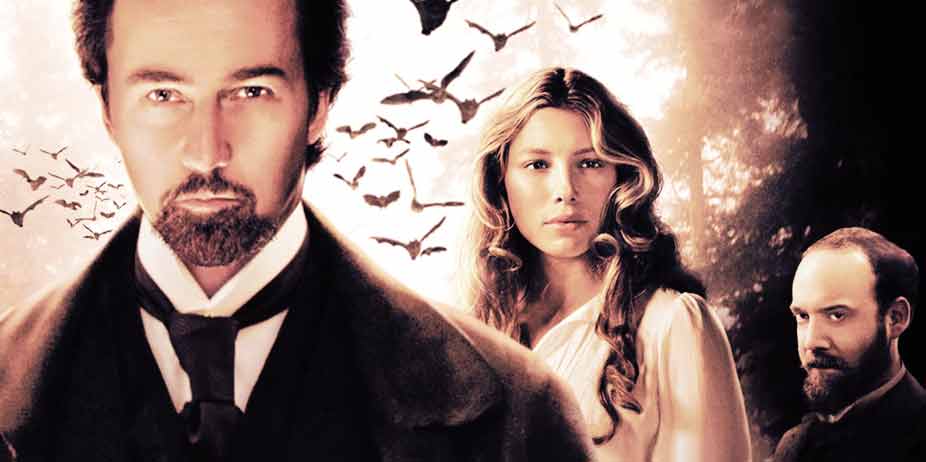
The Illusionist (2006)
Once in awhile a movie comes along that captivates me from beginning to end. Such is The Illusionist, a film that has enchanted critics and audiences alike. Most of both of the showings I attended were sold out, and everyone leaving in the swarm around me complimented the film on how beautifully put together it was. It is, to coin a phrase, mesmerizing, and even better the second time through.
Flickering gaslight illuminates faces watching in grave expectation as a single man is seated alone on the stage. Before his outstretched hand grows a blue flame that begins to take shape but then vanishes as the police place him under arrest. The figure is Eisenheim (Edward Norton), renowned throughout Vienna for being an incredible master of illusion. Having chanced across a magician as a child, his fascination prompted him to wander the world and the orient in his youth, learning the tricks of the masters. One evening, shortly after his return to his homeland, Eisenheim meets Countess Sophie (Jessica Biel), the young woman he loved in his youth, before her parents separated them. It does not take long for Sophie to learn who he is. Their reunion and resulting romantic passions spark the jealousy of Sophie's bad-tempered fianc, Prince Leopold (Rufus Sewell). Intending to overthrow his father and become Emperor of Austria, Prince Leopold is determined no one will stand in his path to greatness. Concerned Sophie will reject his attentions in favor of the charming illusionist, the prince orders his faithful ally, Chief Inspector Uhl (Paul Giamatti), to find cause to have Eisenheim banished from the realm.
Fascinated with the Illusionist's powers, the inspector finds it difficult to separate the lovers, whose plans to run away together are thwarted by disaster. The consequences scandalize a nation, prompt a murder investigation, and drive Eisenheim to darker forces. Opening a new brand of theatre on a darkened street, he commands a loyal following that threatens the balance of an empire. Everything about this film is exquisite, from the softened hues of filmmaking to the understated and powerful performances. While the story is not particularly complex and intelligent viewers can sense its twists before all is revealed, it really does not much matter since it is so enjoyable to watch. Edward Norton really is the cornerstone of the film, and plays it beautifully in an performance that resonates with soft-spoken dialogue and utter charm. I haven't seen a more likable Victorian character in a long time. I did not think Paul Giamatti could possibly top his remarkable performance in The Lady in the Water, but he is truly magnificent as the inspector, boyishly enthusiastic one moment and melancholy the next. What truly stands out are the illusions, most of them unexplained but entirely possible. Then too, there is an element of magic that makes you wonder how much of it was fabricated, and more than slight of hand.
Out of this comes the single disconcerting element that might initially trouble Christian audiences. The second half of the film is devoted to Eisenheim's newfound recognition as a medium, able to lure spirits from beyond the grave. These spectral figures appear as floating faces above mirrors, and fully formed visions passing through the audience. Without revealing too much, I cannot explain the ultimate conclusions drawn, but nothing is as it seems. The séances are nothing more than elaborate illusions. Apart from that, the only disappointment I had was in an impromptu and unnecessary love scene between Eisenheim and Sophie. It was brief, and shot in such extreme close-ups that it is often difficult to discern what one is looking at, but nevertheless unfortunate. The rest of the content is hardly worth mentioning. There are implications of murder, and a suicide by gunshot to the head. A body is found in the river, and a wound located on the throat, indicating the individual bled to death after being stabbed. The prince asks if Sophie and Eisenheim have been "fornicating" on two occasions. There is one muffled use of "d*mn." Whether Eisenheim was a sorcerer or an illusionist is never truly explained, but concluding scenes imply the latter. The prince jokes to a crowd that Eisenheim has sold his soul to the devil in exchange for magical powers. While some of the later scenes are rather atmospheric and eerie, The Illusionist reminded me of a fairy tale in which nothing is quite as it seems.