The Missing (2003)
Since the bygone days of Jimmy Stewart and John Wayne, westerns have fallen by the wayside. Ron Howard's attempt to resurrect a bygone branch of classic cinema may not have the critics flocking to the box office but carries a wallop when it comes to delivering rock-solid character development and nail-biting suspense. His style lends a picturesque flavor to a complex storyline without overwhelming the audience with the characters' minute odds of success. Throughout the tale we come to respect and admire the leading roles despite their flaws, while feeling a growing fear and hatred for the villain, an Indian witch-doctor (a barely recognizable Eric Schweig). Overall the film is too long, but most adults and teens could glean some thought-provoking conversation through events as they unfold.
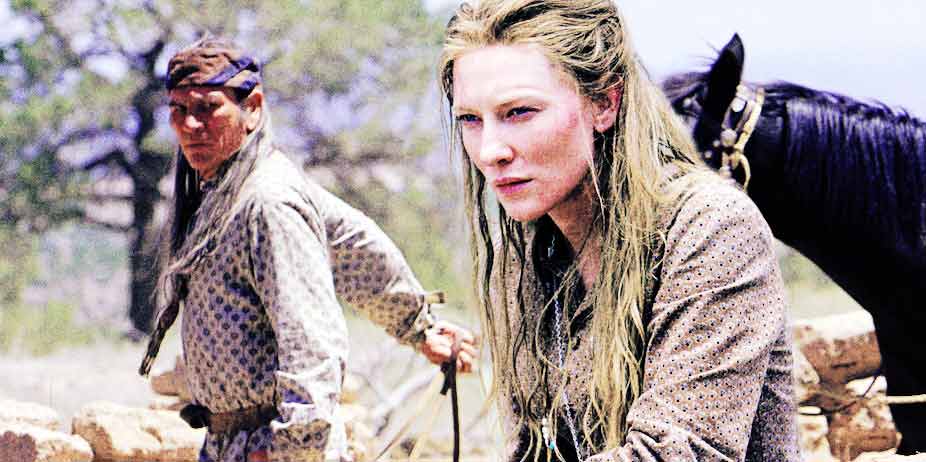
Maggie Gilkenson (Cate Blanchett) is a healer, rancher, and mother of two strong-willed daughters. Dot (Jenna Boyd) is a tomboy, while her older sister Lily (Evan Rachel Wood) longs for city life and fancy frills. They live on a homestead in upper New Mexico with Brake (Aaron Eckroyd), Maggie's lover, and a Mexican ranch hand. One evening while investigating the death of one of the livestock, Brake meets up with a mysterious white man turned Indian seeking Maggie's healing touch. The grizzled figure is allowed to spend the night in the barn but makes an unannounced and unwelcome appearance at the dinner table, where Maggie immediately sends him out of the house. Samuel Jones (Tommy Lee Jones) is Maggie's long-lost father. He abandoned his wife and children in favor of an Indian lifestyle, resulting in the deaths of his wife and son.
Willing to suture his wounds but not offer him forgiveness or reconciliation for a twenty-year absence, Maggie orders him to leave the ranch. The following day her daughters, Brake, and the ranch hand ride into the hills to brand calves. When they fail to return, Maggie is forced to investigate... leading her to a grisly discovery in the woods. Her lover and the ranch hand have been brutally murdered, and Lily taken as captive by Indian renegades. The Rangers have long been on the trail of these murderous deserters but are lead down the wrong path. Initially believing her father to be responsible, Samuel becomes the only man Maggie can turn to in order to track down her daughter and rescue her from a life of slavery in Mexico. Blended in with the tale is a subplot involving Indian witchcraft, since the brutal leader of the renegades is a shaman. When Maggie starts getting too close, he takes matters into his own hands in order to delay and harm her.
Both mysticism and Christianity are explored. Maggie is religious but falls prey to an enemy curse. Her father and an Indian chant holy prayers in native languages in order to restore her, while Dot reads from scripture in the background. Something about a Christian woman being healed primarily through primitive heathen methods is troubling. There is a large amount of witchcraft but none of it is portrayed positively. Chidin hangs rattlesnakes from trees and chants beneath them; he repeats spells while rubbing strands of Maggie's hair between his fingers, and blows dust into people's eyes, resulting in eventual blindness. Much emphasis is placed on forgiveness, redemption, and repentance for past mistakes, and Maggie is often shown in prayer. The Missing's strongest appeal comes in the form of the father/daughter relationship, which is fearlessly explored by two exceptionally talented actors. Cate Blanchett has long been worthy of an Oscar, and this role may very well be the one to garner her the respect that goes with a golden statuette. Maggie is emotional and yet restrained, strong when threatened but equally vulnerable. Her past is dark and intrusive, but she overcomes former weaknesses and loves her children deeply. Tommy Lee Jones is also extremely winning as her unrepentant father; we feel a natural affection for him early on, which only increases throughout his attempts to make things right with his daughter. One might imagine the remarkable ends there, but the two young actresses involved -- Evan Rachel Woods and Jenna Boyd -- are also stunning on screen. The cinematography is brilliant, and the musical score lends to the haunting atmosphere. But along with the stunning footage comes violence and thematic elements.
Language and sexual content are mild. There are half a dozen mild profanities, some of them in subtitles. Maggie and Brake "live in sin" on occasion together; usually he bunks in the barn, but spends one night with her in the cabin. A captor holds a gun to Lily's head and pulls at her skirt but is knocked unconscious by one of his companions. It's intimated through cryptic conversation that Lily is the result of rape. From a distance we see the blurry backside of a naked, dead man. This film carries an R-rating but I'm convinced the rating comes more from thematic elements than violence. Much of the combat, shootings, and fistfights are not overly graphic or gory. The implications are much more profound. It's implied a man is beat to death on the head with a painted bone. The blows are glimpsed either from a distance (in which we cannot see the man's head) or heard as the camera lingers on Lily's horrified expression. People are shot and killed.
A pink bag is found in the dirt, presumably containing a man's heart. Probably the most horrific incident is a brief glimpse of a man's remains found hanging in a deerskin bag over a campfire. Dot intimates she heard him screaming for hours during the night as he was slowly charred to death. We briefly see his face in a couple of shots. The description of problematic content sounds worse than the actual visual experience, and while the shamanism/medicine man elements are woven throughout the story, they don't bear a great deal of influence on the viewer other than repulsion. Without even meaning to, the film offers a strong case for the right to keep and bear arms while taking a subtle dig at corrupt government. At one point Maggie hopes to rely on the rangers to assist them in the capture of the renegades, but the officials are more interested in looting private homes and bearing captured outlaws south than risking their lives to protect US citizens. The ending is bittersweet. The Missing is a good western, and an even better character study, but won't appeal to everyone who sees it.