The New World (2005)
If you ever went to high school, you should remember sitting through a history class revolving around the Indian princess Pocahontas, and the early Virginian settlement. It's been a long time since I wrote a four page report on John Smith's narrow escape from death but this film has brought back a lot of forgotten points to me. It is surprisingly accurate (though romanticized) and free of objectionable content, but I couldn't help wishing that it had a bit more energy to it.
As the ship approaches the new world, natives gather along the shore, peering through the high reeds as they watch white-faced settlers disembark. Among them, bound in chains and due for hanging, is Captain John Smith (Colin Farrell). Granted a temporary pardon but stripped of his rank by the commanding officer (Christopher Plummer), Smith is chosen among the others to travel upstream and make peace with the Indians encamped there. Chief Powhatan (August Schellenberg) is hostile toward the invaders, whom he perceives as a threat, but before Smith's brains can be bashed out in a ritualistic killing, the chief's daughter Pocahontas (Q'Orianka Kilcher) pleads for the prisoner's life. Smith is granted his life and allowed to remain with their people. Over time he develops an attachment for the princess, who strives to learn the English language and harbors growing romantic feelings for him.
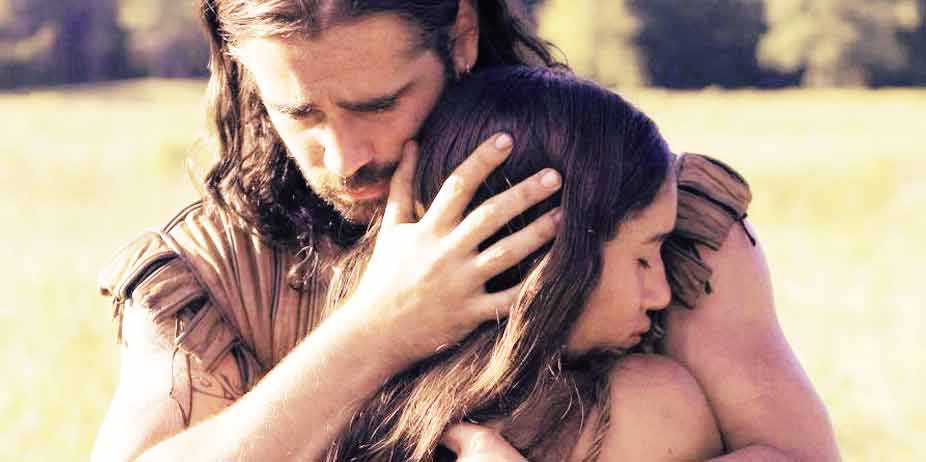
His return to the settlement reveals the white settlers on the brink of starvation and it is only through native intervention that they do not perish in the long, cold winter. But while he struggles with his love for the princess, strife between the colony and natives reaches a boiling point. The story follows historical guidelines and ultimately introduces the character of John Rolfe (Christian Bale) but is mostly a softly spoken romance. Historians believe Pocahontas was between twelve and fourteen years of age at the time she pleaded for John Smith's life, and there are no actual indications that there was an attachment between them beyond friends. The actress looks significantly older and this softens the twenty year age gap. Then too, there are no overly physical romantic scenes, just a lot of hand-holding, touching one another's faces and hair, and the occasional half-kiss.
Scenes of violence are very brutal and shot in close-ups. Settlers are beaten to death. Indians are shot and killed. Arrows fly through the air and lodge in chests and throats. Pocahontas is treated roughly by her father's warriors when she is dragged before him. Some of Pocahontas' costumes are somewhat revealing. There is barely any profanity -- because there isn't a lot of dialogue. Much of the film is told in narrative with voice-over when it would have been more interesting through conversation. I enjoyed the movie overall but also felt as though it was far too long (the two and a half hours felt more like five) and without passion. It was very pretty to look at, but if I wanted lots of lovely shots of birds and picturesque swampland in the setting sun, I would buy a travel video. The scenery seems to detract from the plot rather than add to it, because the storytelling moves too slowly to provide a rich forefront for such a dramatic backdrop. It was, in a word, boring, and most of the audience I saw it with said as much as they were leaving the theatre.
I appreciate that the filmmaker chose to keep it as historically accurate as possible and strayed away from the ever-pressing threat of political correctness, but I question his method of approaching the material in such a way that will only appeal to "artsy" individuals. Most high school students would much rather read the one chapter in their history books than sit through the film, and that's too bad. It had a lot of potential but didn't succeed in fulfilling enough of it. There were some truly wonderful moments, and the acting was beautiful, but to me it felt as though there wasn't enough melodrama. With such a story of loss and betrayal, there's room for it. I was also disappointed that the script overlooked Pocahontas' conversion to Christianity, instead leaving us with the impression that she never rejected "Mother" Earth.