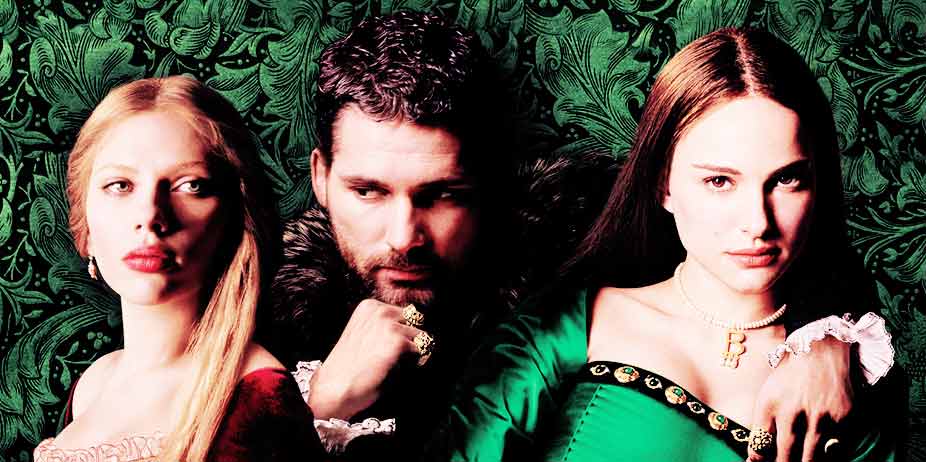
The Other Boleyn Girl (2008)
Philippa Gregory has long been criticized for playing fast and loose with historical facts in her novels. I have read a handful of them and did not like their malicious depiction of most of the women in history I most admire, so I did not quite know what to anticipate going into the star-studded film. To my surprise, while The Other Boleyn Girl remains inaccurate, it is surprisingly memorable and poignant, even though it plays fast and loose with everything ever penned in the history books. If you know the period, you will be distracted with the discrepancies. If you don't, you may find this adaptation of events interesting.
When Henry VIII (Eric Bana) loses his last hope for a male heir through his wife's miscarriage of their son, it becomes obvious that he will soon seek to console his emotions in a mistress. While most of the families of the court would clamber for the public recognition and favor such notice of their daughters would bring, it is the Duke of Norfolk (David Morrissey) that decides to take matters into his own hands. Hoping to keep the seat of power in his own family, he encourages his brother in law Thomas Boleyn (Mark Rylance) to set his youngest daughter Anne (Natalie Portman) to the task. Disinterested in "bedding the king" until she is assured Henry will find her a profitable marriage once it is done, Anne intentionally sets out to captivate him on a hunt, but her exuberance leads to the king's humiliation (and therefore his resentment of her) when he suffers a bad fall. Fearing the king's resulting displeasure, Norfolk sends in the quieter, gentler, recently married Mary (Scarlett Johansson) to console Henry and bandage his wounds. Her innocence ignites his interest, which drives a wedge between the sisters as one starves for attention and the other must unwillingly submit to it. Mary soon falls in love with the king, but when she is forced into early confinement to ensure she does not miscarry his child, it once more lies with Anne to maintain his interest in the Boleyns, but little does anyone realize that her brief taste of power has given her ambitions that will dethrone a queen and shake England to its very foundations.
The Other Boleyn Girl has a great deal going for it: a historical backdrop, a bestselling novel, and two of the most popular leading ladies of its time. It has absolutely gorgeous costume design and a good score. It also had an ambitious director most recently acclaimed for Masterpiece Theatre's Bleak House, but his experience on the small screen has not entirely prepared him for thirty foot theater screens. The first twenty or so minutes feel clumsy and forced, with too many close-ups to establish different moods and surroundings. Fortunately, that did not become a pattern for the rest of the film, since eventually the camera did pull back and allow the audience to breathe. After Mary became romantically involved with Henry, the story picked up momentum and I soon became lost in the scheming ambitions of Anne, the quiet desperation of Mary, and the determination of Katharine (Ana Torrent) not to go down without a fight.
I liked that the film showed Henry's reluctance in divorcing his wife, as well as an increasing frustration toward Anne that transforms their relationship into a power struggle which soon turns to hate. All the actors are exceptional but the men are often overshadowed by the women. Johansson is deep and heartfelt, easily crushed and prone to tears. Portman is full of so much strength, temptation, and ferocity that one can see why Henry moved heaven and earth to have her. In less than a half dozen scenes, Torrent causes us to love her conviction and resolve as the tormented and jilted queen, but the real surprise for me was Kristen Scott Thomas as the girls' mother, increasingly frustrated as the men in her life send her daughters down a dark and unfortunate path, but powerless to do anything about it. The moment she breaks down and slaps her husband has been building throughout, and the audience feels more deeply for her than the leading ladies.
Unfortunately, for all its magnificence the film does earn its rating in the form of sexual material and, more disturbingly, a brief but horrible scene in which an infuriated Henry, prompted through rage over forcing to abandon Katharine and facing the eternal separation from the Roman Catholic Church, storms into Anne's chambers and when she refuses to give him what he desires, rapes her. There is no nudity but it's apparent from her frantic tears and the positioning what is going on. As unpleasant and violent as the scene was, it did play a major role in setting up the emotions and events that cascade through the rest of the film, but I felt the vile act could have been alluded to more than shown. (Each time I attended a showing, the audience was in absolute shock.) That is the most major strike against the acceptability of the film for wider audiences, but there are also two love scenes between Mary and Henry, filled with tender caresses and kisses, and an awkward wedding night scene with her husband.
Frequent dialogue references marriage consummations and whether or not the king was "satisfied" with Mary. Anne confesses that their marriage is so unhappy, she must resort to "degrading acts" in order to please him. The most shocking moment is when she begs her brother George to sleep with her, so she might produce an heir to the throne after a secret miscarriage. It seems they may go through with it, but they cannot bear to. There are two executions and though the actual impact is not shown, both are traumatic for the audience, and a pan out shows a distant body laying in a pool of blood. I will not even touch the historical inaccuracies, as they are so vast it would take sixteen pages to outline the complicated sequence of events that are so carefully rearranged for cinematic purposes. (For example, the true Mary Tudor was well known for her promiscuity, not the virginal and naive woman depicted here, nor did she bear any of Henry's children.) The film also fails in providing us with certain important details -- Mary's husband vanishes without a trace and we are never told what happened to him, only that she remarries later in life. Likewise, ten minutes after Katharine's impassioned speech about not relinquishing her throne, Anne Boleyn is being crowned queen.
If you have read the novel, you will know the direction the story goes, but if you have not, it is fair to warn you up front that this Anne Boleyn is a little more villainous than she has been depicted in the past. The audience does feel deeply for her, but it is heavily insinuated that all that befalls her is just one step away from being justified through her own inappropriate quest for power. Overcome that, and you will enjoy it, but if you have a romantic heart and desire to believe that Henry and Anne truly, deeply loved one another if only for a short time, Anne of the Thousand Days is much more suitable.