 The
Scarlett Tunic (1998)
The
Scarlett Tunic (1998)
Anyone will tell you that I do not care for Thomas Hardy. His books and therefore the adaptations based on them are what my mother commonly calls "depressing," and while I may forgive a certain morbidity in most literature, I rarely like his protagonists and only infrequently find the ultimate conclusion enjoyable. The Scarlet Tunic is no exception. Based on a short story, the film takes numerous liberties to the extreme, some I am not entirely certain the author would appreciate.
With Napoleon making attempts to conquer Europe, various foreign armies have chosen to send their countrymen to England to enlist with the British in an effort to suppress him. Encamped throughout the northern country, taking up residence on the donated land of various estate owners in the district, their presence is made aware to the townspeople but rarely seen outside the camp. Among these gallant scarlet-coated heroes is Matthaus Singer (Jean-Marc Barr), an army officer who only wants to return home, and dreams either of soon fighting or retiring honorably to the land of his ancestors. One afternoon, he encounters Frances (Emma Fielding) while on a walk across the property and the two begin an unlikely friendship. Eager to be married and in the hope of pleasing her father, Frances has accepted the proposal of a young man in Bath. But he has not returned in months, nor written any letters to her since the initial offer, and she has become concerned with rumors that he may be seeking the hand of another young woman of higher social standing.
Matthaus' love of poetry and his romantic ideas fascinate her, and they conduct a secret romance by way of accidental meetings. In doing so, Matthaus is risking his honor and his place among his friends, for if he is caught off army property, he will be punished. Likewise, his fellow soldiers have become tired of army life and long to escape. Learning that the war is soon to end, they are horrified to discover that they will not be freed from their posts, but instead shipped off to India to assist in maintaining British supremacy in the region. It is enough to create discourse and start them plotting for rebellion. Having obtained a means of getting across the channel, they plead for Matthaus to come with them, but he will not leave England without Frances. What unfolds is a stirring and romantic story revolving around self-serving cowardice. Even if their presumed future deployment to another front was unfair, they had made a promise to serve in the English army, and desertion was unacceptable. I was not fond of any of the men for that reason, and that made me not really invest emotionally in the storyline.
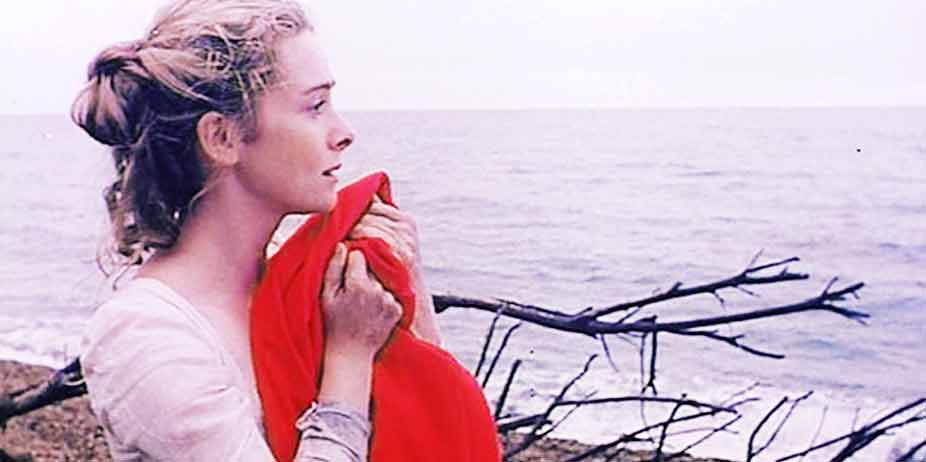
The acting is quite good but Fielding does not bring much emotion to Frances, or at least nothing I could really connect with. I was not certain of her motivations throughout, which is the fault of the writers -- I could not discover if she was just eager to be married, or if she wanted to please her father and leave the house. There was a sub plot involving a young woman of Frances' acquaintance and Matthaus' younger brother but it came and went so quickly that when they were reunited at the end, I had forgotten about it and it took me several minutes to figure out who these people were. The surrounding countryside was beautiful and the filmmakers took advantage of the wonderful old houses and rocky shoreline with some very beautiful scenes. There were aspects about the unraveling romance that were quite sweet, and I liked Frances' little sister very much. A few meaningful glances were even shared between her governess and her father, and that brought in a different flavor of anticipation. However, there is one thing in particular that felt tremendously out of place and inappropriate.
Thomas Hardy was something of an idealist in his exploration of characters and the consequences that took them to bad ends. I sense that he saw everything that was wrong with society and sought to exploit the various weaknesses in it through his writing. The theme of choosing unhappiness was explored in The Return of the Native, and he came down hard on self-serving, unforgiving men, as well as hypocritical Victorian morality, in Tess of the D'Urbervilles. Not having read the original story on which this is based, I cannot say with all confidence that premarital sex was not something he explored in it, but I have the feeling that addition was something contrived by the writers in order to convince us this was true love. Not only does Frances willingly shed her clothes for Matthaus (out in the open, on a beach, no less), but his brother and a town girl share a frolic in the hay, something I doubt would have happened given the strict moral code of the early 1800's. They are seen partially undressing and kissing one another before the scene cuts out. Matthaus strips Frances to her waist, and the camera catches a glimpse of her bare breast when he pulls her to the ground to kiss her. The scene felt inappropriate and was too long, even if it did not involve movement of any kind.
A handful of profanities are present, along with some semi-graphic violence: several people are shot in the chest and killed. Blood spurts when they are hit. There is the traditional tragic ending. I would not have minded the film so much if it had felt truer to the characters, but the addition of premarital sex and nudity did nothing to further the plot, and only made me dislike the eventual outcome all the more. I am not an avid lover of Hardy, however, so my opinion must be taken with a grain of salt.