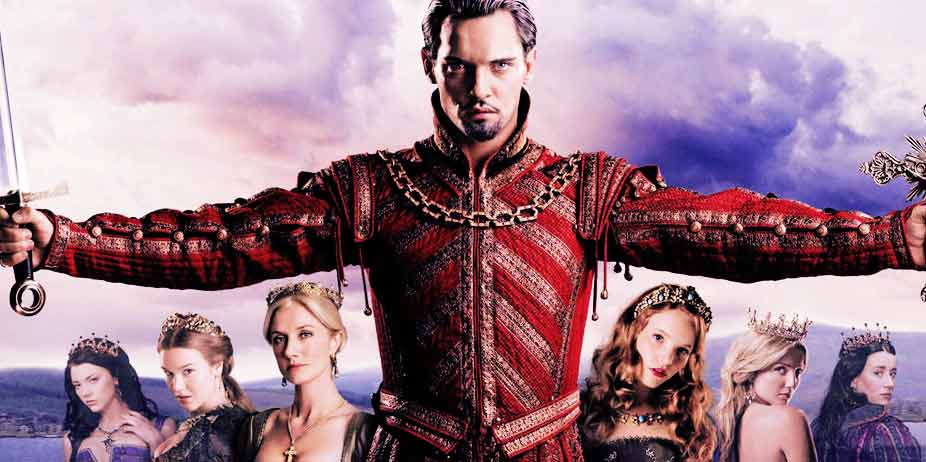
The Tudors, Season Two (2008)
I looked forward to the second season of The Tudors with mingled anticipation and dread. As a fan of the historical events involved, I knew it would be an intense, moving, emotional, and ultimately devastating experience. The second season is more focused and stronger than the first, but ends on a far more tragic note.
England lies beneath political and religious turmoil, for in his quest to seek a divorce from his Spanish wife Katharine of Aragon (Maria Doyle Kennedy), the ruthlessly ambitious and lustful King Henry VIII (Jonathan Rhys Meyers) has been forced to turn his back on the Roman Catholic Church. Driven by his passion and determination to possess the beautiful but manipulative Anne Boleyn (Natalie Dormer), Henry confronts his Parliament with a dangerous ultimatum: each member of government must choose a side, either to remain loyal to the Pope or to swear their allegiance to him as the ultimate moral authority in England. This deeply grieves the conscience of his dearest friend and former counselor, Sir Thomas More (Jeremy Northam), who resigns his public office and requests to withdraw quietly into the country, hoping he will not be forced to choose between king and conscience.
Reformists are using Henry's break with the Church as an opportunity to build a new regime built on the foundations of Lutheranism, and their ultimate ambition is to take down the Catholic establishment in England. But there are strong voices of opposition -- viewing Anne Boleyn as the instigator of this unwanted change, priests throughout London threaten dissent through sermons condemning the king's adulterous relationship. Thomas More fights a subtle battle behind the scenes, while his friend Bishop Fisher (Bosco Hogan) is more public in his protests, so much so that Thomas Boleyn (Nick Dunning) schemes his immediate and unfortunate death. Hoping to placate his mistress' resentment that Katharine is still in residence at court, Henry sends his unhappy wife into exile, much to the anger and resentment of their daughter Mary (Sarah Bolger), and increasing the disapproval of his friend Charles Brandon (Henry Cavill).
Brandon has realized the perils in allowing the Boleyn family so much influence and becomes violently but secretly opposed to Anne. But as she comes into her own and is crowned queen, Anne's innocent flirtations with Mark Smeaton and the doubts concerning her former relationship with Thomas Wyatt become important in the violent upheaval, jealousy, and political anguish that follows. Most of the critics complained this was not as "fun" as the first season, and indeed it is not -- but the historical events were not fun either and results in the loss of four of the show's outstanding leading actors. There is a third season planned with hope for a fourth, but the second season in many respects is so fine an achievement that it will be difficult to top. I have two complaints. The first is that it moves at an alarming pace, racing through certain events where more time should have been taken to explore them. The second is that Katharine is so significantly downplayed that the show suffers without her. Fans adored her in the first season and having her in only a handful of episodes is sad. That said, the actress can still break your heart with a single tormented glance and her death scene is devastating to watch.
The series features some outstanding performances, mostly centered around the unfortunate martyrs of the court. Jeremy Northam gives a heart wrenching realism and humanity to Thomas More, taking us through his desperation and horror to the horrible moment of his death. His friend Bishop Fisher, who won over my heart in the first season with his adamant defense of marriage, had a similar moment of passionate torment and fear as he faced his own mortality. Between them, and along with Katharine's consistency in her devout faith and endless emotional sacrifices, there is a surprising amount of poignant and profound wisdom. All three go to their deaths without harboring any hatred for their enemies. Fisher and More defend their faith to the last. The writer has also taken pains to include Katharine's historical speech on how she does not hate sorrow, for in sorrow she finds herself drawn closer to God than in times of happiness.
Their remarkable actions are comparable to the selfish and often sinful actions of the Boleyns, painting a severe contrast between true devotion and faith and faith merely for the sake of political advantage. Natalie Dormer is phenomenal in her final episodes, carrying the audience along with her as everything crumbles in her wake and leaves her emotionally devastated and physically vulnerable. Her death did not "get me," but the sequences leading up to it did. While season one was marred with abhorrent sexual content and nudity in almost every episode, the content has been much downplayed in the second series but is still present. There is upper female nudity in three episodes, backside nudity in two of them, and three graphic but clothed sex scenes, along with a long and disturbing rape. Continuing with the inaccurate theme from the first season is the presence of a homosexual sub plot, this time between George Boleyn and a court musician. Nothing is ever shown of their physical relationship, but they smile, flirt with, and caress each other. Knowing her husband has taken a mistress, Anne struggles to place in his path a woman that will not threaten her position. Charles Brandon, meanwhile, promises his young wife he will remain faithful -- and does, for five episodes, before he has a momentary fling. (However, it must be noted that through his wife's devastation, his behavior is changed and he is sorry for it.)
Language is occasional but does include one utterance of the f-word. There are several executions -- most of them are implied but two are shown with severed heads and twitching torsos. Protestantism takes a beating because a large portion of the plot is devoted to the Reformation taking root in England. Catholic churches are broken into and burned. Statues are overturned. Stained glass windows are smashed. Lutherans spit on images of the Virgin Mary. To me, that was extremely difficult to watch because it was such an unfortunate, intolerant, biased period in religious history. There are less historical inaccuracies this time around, but errors are still obvious to anyone with any knowledge of the period. The series' stronger moments come from Anne Boleyn's increasing hysteria, the introduction of Jane Seymour, the birth of Elizabeth, and the presence of Mary. One immensely touching scene has her holding her baby sister and singing to her, a symbolic image of what the future is to bring. Peter O'Toole also joins the cast as the Pope, and his dry humor brings much needed smiles amidst the torrent of tears that follow the deaths of various beloved characters. It is far from perfect and sometimes perverse, but if it were not, it wouldn't be The Tudors.