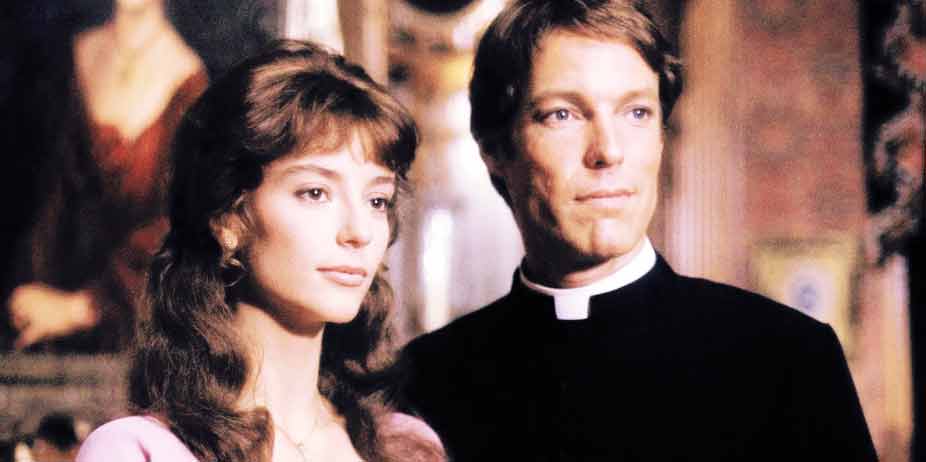
The Thorn Birds (1983)
An emotionally draining and powerfully stirring miniseries, The Thorn Birds is a controversial love story that questions the Catholic faith and God's gifts to mankind.
In the early 1920's, Father Ralph (Richard Chamberland) has come to the Australian outback in the hope of earning his way up the hierarchy of the Church. Temporarily banished for disagreeing with a higher member of the order, Ralph must rely on the generosity of the wealthiest woman in the district for his ticket to power. Mary Carson (Barbara Stanwyck) is old, eccentric, and more than a little lustful of the handsome priest. A widow without children, there are only two possibilities for her future will: to leave her fortune to her impoverished brother Paddy (Richard Kiley) and his family, or to grant Ralph what he desires and in doing so assure his return to Rome and a position as a Cardinal. Deciding to play them against one another, Mary sends for her brother and his wife Fee (Jean Simmons). They have a passel of boys and only one girl, Meggie. The eleven-year-old is neglected by her mother, who "only sees her sons" because male children are the "triumph of every woman's life," but adored by her eldest brother Frank (John Friedrich), who has a tumultuous relationship with his father.
Compassionate toward her plight, Father Ralph takes Meggie under his wing, offering her the love and reassurance she so desperately needs. When her wealthy aunt pays for her to attend his school, the priest gives her the comforts of home by allowing her to live with his housekeeper in the parish rather than among the other girls. With Frank growing increasingly unhappy with his parents, Fee pregnant again, and Mary keeping a careful watch on her favorite cleric, it is only a matter of time before the facade of happy existence they've woven comes tumbling down. Ralph set out to become a true man of God, but cannot seem to lay aside his human desires. He wants the love of a good woman, but his vows prevent him from finding true happiness, and he cannot understand why little Meggie gives him such joy. As a child she is like a daughter to him; he can cling to her to without fear of rejection or suspicion, but as the years pass Meggie (Rachel Ward) grows into a beautiful woman. Meggie is passionately in love with him by the age of seventeen and his emotions toward her are not entirely priestly. Mary observes this entanglement in the making and decides to make the best of it. She vows to steal the priest's soul at the cost of her own and leaves him to make a terrible choice between power and love, happiness and misery, chance and fate.
From beyond the grave she continues to haunt him as he follows the workings of her will and inevitably faces devastation. As Ralph rises in the church under the tutelage of Cardinal Vittorio (Christopher Plummer), Meggie finds temporary happiness in the arms of another man, but they will eventually be driven back together again. While this miniseries is just as controversial as the novel on which it is based, there's also something intoxicating about it. We become emotionally involved in the journey, learning to love Ralph as Meggie does -- in spite of his profound faults. We entertain pain, sorrow, laughter, and triumph, while our heart breaks for these two sincerely lost souls. Ralph is confronted with the knowledge that he is a man and needs a companion, not just of the body but also the soul. Because Meggie fills this place in his heart, his faith is tormented, for he believes God should be at the center of his life. Watching him struggle is made all the more painful for us because we know eventually he will submit and break his vows. Ralph does not give up the church for Meggie, but does share a passionate four day liaison with her. He continues this physical relationship twenty years later yet has no shame in professing to be a man of God. Meggie also uses every opportunity to slander God, blaming Him for "taking away everything she has ever loved." There is a redeeming element in her son being entirely devoted to God, far more so than his parents -- he is the perfections in them both, without any of their failings, and his faith permeates the last half of the series.
Still, these aspects do not recommend themselves to more cautious viewers. I enjoyed it as it unfolded, and have grown to respect it as a remarkable project over the years, but it still stirs some negative emotions within me. I was happy when Meggie and Ralph finally got together, when I should have been dismayed -- he was a Bishop at the time, and she an [unhappily] married woman. Yet there are underlining truths woven throughout -- Ralph fails as a priest because of his ambition. It is what drives him, far more than devotion to God, and in this respect we see all his faults and how much it hurts not only him, but those who love him. One could even argue there is a certain amount of veiled spiritual symbolism involved, with Drogeta playing the role of Eden, Mary Carson as Satan (even she admits it, in one fascinating theological discussion), and Meggie as the tempting Eve that led Adam into sin. The morals are all askew but there is something brutally honest in its exploration of love and lust. With these themes carrying throughout, viewers have probably already made up their minds whether or not to give The Thorn Birds a chance to take wing, but some content issues do bear mentioning. There is no graphic sexual content (this was filmed and shown on television in the '80's) but many implications, lengthy passionate kissing scenes, "morning after" shots, and sexual dialogue, as well as distant side nudity on Ralph. He towels off after a rainstorm on the porch and Mary Cleary comes out to comment on how beautiful he is. She makes several lustful overtures toward him at various points (asking to be kissed, flirting with him, licking his finger as he gives her communion). Much is made about the priestly vow of celibacy. Ralph is forced to deal with a young priest who succumbed to temptation. It is he who explains delicately to Meggie that intimacy is not just mating, but an act of love. He and Meggie share numerous passionate kisses (usually they break off when he resists, but one instance leads straight into bed; lengthy feverish kissing is all we see).
Luke implies he's been with many women and makes mild advances toward Meggie, but when she offers herself to him, he refuses. After their marriage Meggie sets out to get herself pregnant, taking advice from Lady Chatterley's Lover and manipulating Luke into lovemaking without a contreceptive. Conversation references it later, along with how painful her "first time" was. After her adulterous tryst with Ralph in a beach cabin, Meggie learns that her mother followed a similar path when she was young, and became pregnant by a married man. The cardinal waves aside Ralph breaking his vows for the sake of reminding the priest he's been humbled in the knowledge that he's just a man after all. There are a dozen profanities in all, along with mild abuse of deity. Half the characters are religious in some form, the other half are either atheists or directly antagonistic toward God. Violence enters in the form of fist fights, boxing, and other sports. Thematic elements are prevalent with several implied deaths (being gored to death by a wild pig, having a burning tree fall on you, a child dying of fever) and disastrous events. There's something meaningful about the story but cautionary. It will offend most Catholics and other denominations will have a hard time overlooking the theme of adultery, but if you do watch it, you will never forget it.