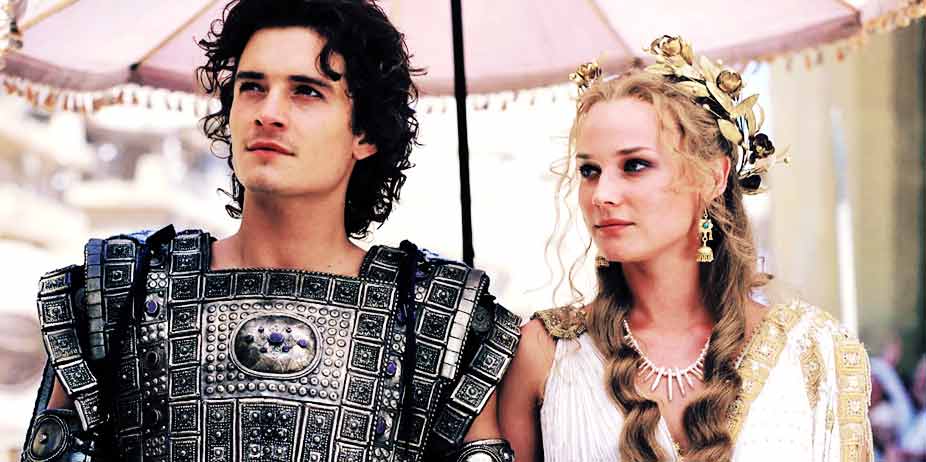
Troy (2004)
When Homer wrote the classic story of forbidden love and
great folly, he never envisioned it would become a classic.
Comprised of a fantastic cast and magnificent sets, Troy
tries very hard to cover up its flaws. Its an interesting
story but fails on many levels. It doesn't have the strong
storyline and moral foundation of The Patriot. It doesn't
have the driving passion of Gladiator. What Troy turns out
to be is a humble attempt at romance without great
conviction in a tale of characters we have trouble
completely rooting for. They are all flawed and human, but
not remarkable. By the end were not sorry to have seen it,
just sorry that it wasn't better.
King Agamemnon has been moving his armies throughout the
empire, conquering one land after another. The only
freestanding province remaining is Troy, seat of the high
king Priam (Peter O'Toole), whose two sons have been sent to
decree peacetime. Working for Sparta is a brutal warrior
named Achilles (Brad Pitt), a soul born to kill men. He
fights not for the empire but out of desire for glory. His
mother (a briefly seen Julie Christie) acknowledges his wish
for notoriety but warns him it will bring his death,
foreseeing inevitable conflict on the battlefield. While in
Sparta, Paris (Orlando Bloom), younger Prince of Troy, falls
in love with the kings beautiful wife Helen (Diane Kruger).
They conduct a clandestine affair in which both are
convinced they have found true love. Paris is due to return
to his homeland and begs Helen to accompany him.
When Menelaus learns his wife has fled with Paris, he
desires to declare war and gain the return of his wife so he
can kill her with my own two hands. Agamemnon has been
awaiting just such an opportunity, an excuse to attack the
nation of Troy and bring it to its knees. Paris older
brother Hector (Eric Bana) warns Paris against the folly of
bringing home another mans wife, but has not the heart to
send him to his death. Paris has promised, if Helen is
returned to her husband, to follow her there, even if it
means his certain execution. When they return to Troy, their
father welcomes them with open arms, also extending his
protection to his son's lover. When the Spartans arrive and
Priam refuses to sacrifice Helen, they attack the beach of
Troy. Inevitably it will bring others to war on their fair
shores, including Odysseus (Sean Bean) and Achilles, who
finds forbidden love in the form of the kings niece Briseis
(Rose Byrne).
While the story begins solidly, it loses momentum midway
through. The battles have no excitement because neither army
battles for anything worth fighting for. Paris wants to keep
Helen at no great cost to himself. He has noble intentions
of saving Troy but fails when it counts and shows cowardice.
The story revolves around Helen but she's barely given any
screen time. Achilles is supposed to be likable but comes
across as more of an arrogant, bloodthirsty jerk. Hector's
wife (Saffron Burrows) has the most empathetic role but not
enough character development. The two noblest of characters
are killed for sport. These men died for nothing. There was no cause for them
to battle for, nothing but lust, pride, and greed. A king
took an army to war because he wanted to rule the earth.
Another fought for revenge over a common, simple mistake.
None of it was honest heroism, just macho displays of
vengeance.
Despite this the film is very engaging and many
of the characters are enjoyable to watch. Hector and his
beautiful wife, Paris' internal struggles with cowardice, the
grief of his father, even Achilles unusual character
alterations. In one scene he's a warring madman, in another
he's weeping for a fallen enemy. He says it is senseless to
go to war and believes loss of life is terrible but deep
down feeds his bloodlust. Its an impossible conflict of
interest, an attempt to humanize a character you simply
cannot root for. He does show great kindness to Briseis
(even though he eventually seduces her) by allowing her to
live, offering her freedom, and fighting for her protection
on numerous occasions from Spartans. This aspect makes him
much more likable, although when he ties the body of a
fallen foe behind his chariot and races it through the
encampment, some of our liking for him fades.
Because of this, as well as some lengthy pacing issues and
an abominable soundtrack (all except for the closing song by
Josh Groban) Troy is not very memorable. There are few
remarkable aspects. The costuming is very rich and the
acting is good. The problem then becomes an
issue of which side to root for. The movie tries so hard to
be fair to both sides that they alienate the audience. If
the story were only about Helen and Paris, we could root for
them. Instead were given glimpses into not only
their romance, but Achilles relationship with his
impressionable young cousin, his romance with Briseis,
Priam's concerns for Troy, Homer and his wife, and the
King of Spartans plans to rule the world. Characters also die out
rapidly; some of the most beloved heroes fall beneath the
blade, as well as the bad guys. It's worth seeing once if
you're a fan of the cast, but not a classic, and certainly
has nothing to teach other than that mankind can be utterly
cruel and foolish. That's the true tragedy of Troy.
Sexual Content:
Many scenes contain implied and/or partial nudity. Men are shown naked from the hips up. Brad Pitt's naked backside gets a lot of screen time. Our introduction to him is lying in the arms of two apparently nude women. Helen removes her top in front of Paris and they kiss; the camera only shows her shoulders. We briefly see her nude backside as she moves from a reclining position. Briseis pulls a knife on a sleeping Achilles; he then flips her down onto the cot and pulls up her tunic (we see most of her bare side) before they kiss and move around on the pillows. A man becomes abusive with Briseis and threatens to harm her, but she is saved. There is a lot of dialogue about adultery, making love, and harming women.
Language:
One use of d*mn, whore, and a b*tch.
Violence:
The battles are brutal with lots of hand-to-hand combat, characters being impaled, arrows shooting down out of the skies, and a few graphic slashes with the blade. There is some blood. One mans throat is slit; another has a sword jabbed through his arm; a woman stabs a man in the neck with gruesome results. Balls of fire roll down a hill, engulfing an encampment in flames. Soldiers burst out of a wooden horse and stab sleeping guards. In one scene two of our conflicting heroes attack one another and one is brutally killed by the other for no purpose other than revenge.
Other:
Ancient Roman religious practices receive a lot of screen time; many conversations about the gods and being blessed and/or cursed by them. Achilles breaks the head off a golden statue of Apollo outside Troy and murders priests. Priests advise King Priam on battle strategy based on signs from the gods, which ultimately leads to the fall of Troy. Briseis dedicates herself to the temple early on, assuming the robes of a virgin until Achilles seduces her.