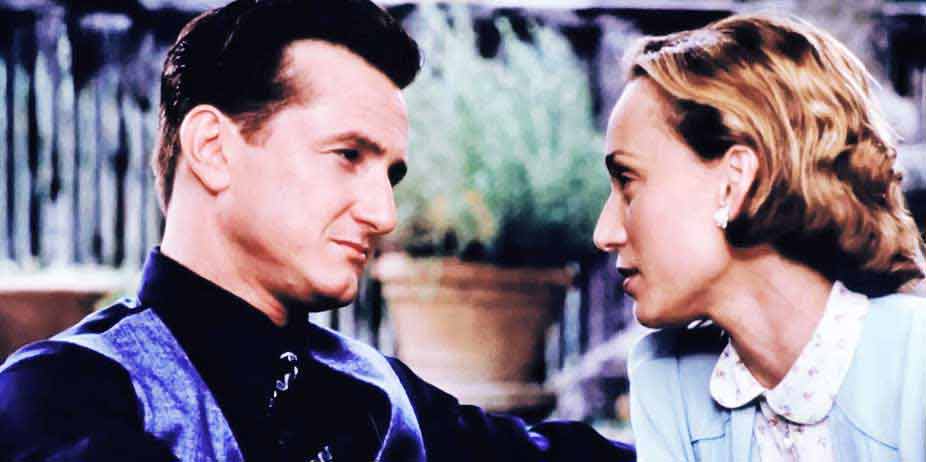
Up at the Villa (2000)
Slow-moving period films appeal to a different breed of viewer; those who enjoy a luxurious pace that allows time for emotion and character development rather than scene after scene of graphic violence or all out verbal battles. In this demographic, Up at the Villa is right at home with beautiful Italian scenery, a brilliant cast, and even a story that is intriguing... if not always openly moral.
The year is 1938, and the city of Florence lies under the threat of war. Thousands of illegal immigrants and refugees are fleeing into Italy to escape the Nazi invasion, but life among the upper aristocrats remains largely unchanged. Dinner parties, dances, and picnics are still in full-force while the rest of the world totters on the brink of chaos. Mary Panton (Kristen Scott Thomas) is a penniless widow whose husband left her almost destitute. Now financially insecure, she is forced to rely heavily on the support and kindness of her well-to-do friends. They have offered her their villa for the summer months, and she finds herself caught up in the midst of political and romantic intrigue when a choice made too spontaneously goes array. Her friendship with the Italian Princess secures her place in society, but then there are the men in her life: Sir Edgar Swift, an English aristocrat and soon to be governor of India. Although older, he has long been in love with her and has offered her financial security and protection if she will become his wife.
There's also Karl, the German refugee who gains her empathy by being mistreated in a restaurant. And lastly, there is the rakish Rowley Flint (Sean Penn), a married American tycoon whose intentions toward her are not entirely honorable. Bored with his marriage and intrigued by her beauty, Rowley favors her with his most sincere charm and elegant appeal, but his attempts to woo her fall flat when she refutes his romantic advances on a roundabout drive home and leaves him standing alone by the side of the road in the middle of the night. Angrily driving herself back to the villa, she very nearly runs over Karl, who is dejectedly walking home after being fired from his job at the restaurant. Taking pity on him and bearing in mind a story that the Princess once confided in her about illuminating a poor young painter's life by having a solitary love affair with him, Mary invites him home to see the gardens. Impulsively she follows in her mentor's shoes and engages in a one-night stand that will forever change her life. Karl doesn't understand that this was a mere act of compassionate pity, and not "true love."
And from this spontaneous, foolish action will stem an act of violence that will leave her with only one confidante in the world whom she can fully trust... an American playboy with a shadowed past of his own... While not fast-moving or even at times difficult to understand, Up at the Villa does teach one thing: the ways that we can unsettle our lives through impulsive sex. Through her carelessness, Mary placed her own life in danger and completely destroyed the life of someone else; the long-term effects are also eluded to... it would ruin Sir Edgar if the truth became known. Sophisticated and sleek due to winning performances by Kirstin Scott Thomas, and particularly Sean Penn as the rakish and yet likable Rowley, unfortunately this is the extent of truth to be found. Having found that I liked Mary despite her foolish mistake, I was much disappointed in the outcome of the film, although it leaves much to mere speculation. She does refute Rowley's advances, and I found myself cheering when she slapped him after an impromptu kiss and peeled out, leaving him standing on the side of the road. But eventually she is attracted to him in return. We're supposed to approve of the match despite the fact that Rowley remains married. The problem is that by the end, you've come to like them both, but feel that sharp prick of conscience at the violation of marriage vows. The end doesn't blatantly come out and say that they ran away together, but does have them meet up on a train... and then leaves you to make up the ending. Did they conduct an affair, or did she merely share with him that last drink and go on her way?
Up at the Villa is a palatable piece of eye candy with realistic surroundings, an intelligent cast, and intriguing premise.
Sexual Content:
Sexual content is more alluded to than shown. One character,
played humorously well by Derek Jacobi, is obviously gay. Subtle
references and glances imply this, as well as the way he walks.
The Princess makes references to past affairs and
takes a wink at adultery, yet is appalled at Mary's
interest in Rowley. Mary and Karl do spend the night
together but are only seen kissing; he then is found
in her bedroom the next morning. A man forces a
woman onto a bed but only kisses her before he gets
back up. Rowley and Mary kiss passionately several
times. One thing I found ironic is the fact that
Mary to Rowley's face says that she will not run
away with him, because "how long would it last?" yet
defends herself to the Princess by saying that "He's
the only one for me."
Language:
None.
Violence:
A man is shot and killed, but the impact is
never seen. Twice people are violently slapped, and
a body is dumped in the woods. A man is shown
bloodied, presumably after being beaten by the
police.
Other:
Even then, the rating is attributed merely to
"thematic elements," which of course are an act of
violence, and what follows. It covers the theme of
adultery, blackmail, and political scandal well.