Upstairs Downstairs, Season One (2010)
As I hear it, the individuals over at the BBC were not too pleased with ITV unveiling Downton Abbey in the late autumn, leaving the station's decision to save this for Christmas somewhat in question. I can see why, because in comparison, Upstairs Downstairs is charming but not as impacting as it might have been alone.
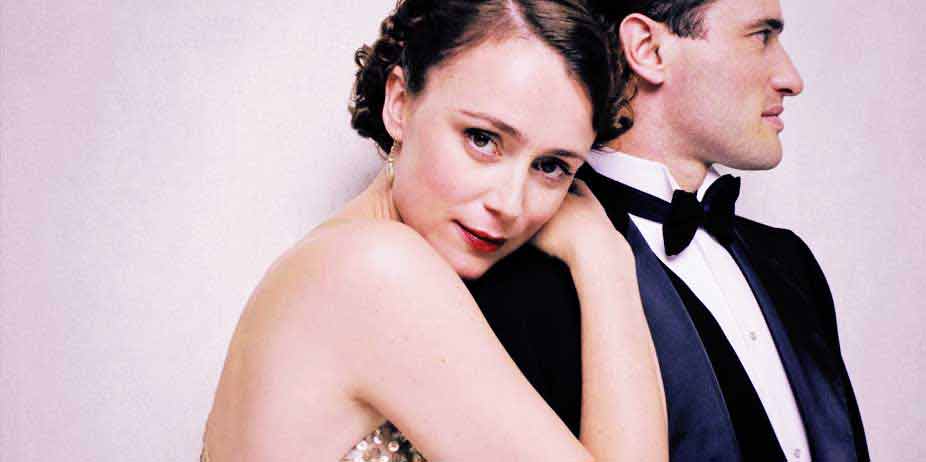
IIt has been many years since 165 Eaton Place was thriving with life, but now a wealthy new couple intend to bring glamour back to its hallowed halls. Lady Agnes (Keeley Hawes) and her husband Sir Hallam (Ed Stoppard) are fairly well known in society and have ties to the monarchy, so a move into a respectable corner of London and the employment of a modest but successful staff are eminent. It does not take Lady Agnes long to seek out and employ the assistance of Rose Buck (Jean Marsh) in finding her a proper batch of servants -- a former employee of 165 Eaton Place during its heyday in the Edwardian era, Rose is excited and reluctant to return to her place of employment, but finds herself becoming nostalgic as she wanders the once-luxurious halls, now in disrepair and desperate need of renovations. More than cobwebs need cleared away... and the house will soon be sparking with controversy, as it doesn't take long for the in-laws to appear.
Recently deprived of her husband due to his trying death (most inconvenient!), Lady Holland (Eileen Atkins) immediately moves in with her distressed daughter in law and her reluctant husband, upsetting the delicate balance of the household with her Indian servant and pet monkey, who prefers orange peels in marmalade. Her arrival contrasts with that of Agnes' younger sister, Persephone (Claire Foy), who enjoys flouting tradition and is rather insulted when servants remind her of the appropriate behavior for upper class females. In the meantime, Rose attempts to convince one of her friends, a rather elitist cook, to take up a position in the household, tries to manage the tea-tootling butler, an impudent maid, and a house boy with a secret, and hopes to prevent Lady Agnes' first dinner party from becoming a disaster when, horror upon horrors, instead of bringing His Highness, the mistress of the king turns up with a Nazi instead!
Having never seen the original series on which this is based (which was tremendously popular in the 70's), I entered this without prejudice and it seems a tad sentimental in the first hour. Audiences familiar with the source material might find Rose's return to the house more meaningful than I did, as well as know something about the memories of the place, but I was left unmoved. There are some excellent things about this series and some that are not so marvelous, namely that it gives too little information and attempts to accomplish far too much in a very limited amount of time. Anyone hoping to have a hint of what is transpiring had best brush up on their politics beforehand, as the series wastes no time in educating its audience, merely thrusting us into the midst of the scandal and drama surrounding the impending abdication of England's monarch in the 1930's, as well as the pro-Nazi movement and invasion of Mussolini into Abyssinia. The characters are likable but it takes a little time to come to know them; most of our empathy is found in the second and third installments, in which we are permitted a better glimpse into their minds. (I particularly warmed toward Sir Hallam, while simultaneously disliking Persephone.)
One thing the series does extremely well is in representing the repercussions of consequences within the house -- such as the political and social ramifications of Persephone's increasing interest in the Nazi party. That is not glossed over and becomes tremendously important in the second episode, when a Jewish servant enters the house. I admit, in my opinion that was the best episode out of the three. The cast is quite good and the costuming and design is luxurious and beautiful -- I gasped when I saw the renovation complete, and the startling inner hall with its royal blue. Beautiful! Claire Foy simpers and smirks and smolders as the temptress younger sister, somewhat outshining her costars, apart from Eileen Atkins, who delivers fabulous one liners with the appropriate smirk.
I did my utmost not to compare this during my viewing with Downton Abbey, but it is inevitable. The latter is like a dish of ice cream, rich, fluffy, and memorable, whereas the former is a cup of strong English tea: you had best drink the tea before eating the ice cream, because the tea could sour in comparison.
Sexual Content:
In the first episode, the maid and the new valet are
flirtatious toward one another; this includes him
attempting to peer in on her under the door to the
bathroom, and her inviting him to come to her room that
night. After some passionate kissing in the corridor,
she ducks into her room and slams the door in his face. Persephone and Spargo,
the chauffeur, are implied to be in a sexual
relationship -- they are shown cuddled up in bed
together at one point.
Language:
Minor profanities.
Violence:
A boy becomes involved in a fistfight that turns ugly
when two other young men intimate that the maid might be
"loose" (the terms they use are crude, but not too
vulgar). Blood spurts after someone is cut on the face
with a piece of broken glass. The crowd at a political
march turns ugly (we are not shown much of the ensuing
riot).
Other:
None.