search: title, actor, etc


 latest updates  ||   archives  ||   bookstore  ||   edited films  ||   mailing list  ||  writer's guidelines  ||   webmaster


VANITY FAIR

REVIEWED BY STEPHANIE VALE


Our rating: 3 out of 5

Because of: brief nudity, sensuality

Rated:


Rebecca "Becky" Sharp (Reese Witherspoon) has grown up with nothing: with an opera singer for a mother and a struggling artist for a father, breeding and wealth are far from her. With both parents dead, she has taken up a post as French instructor at Miss Pinkerton's School for young ladies. Forced to wash floors and clean, Becky is only too happy to jump at the chance to join her only friend Amelia Sedley (Romola Garai) for two weeks of enjoyment at the Sedley home before becoming a governess in the house of a country baronet. But Becky's discontent with the idea of being a governess leads her to take matters into her own hands, as she tries to snag Amelia's only brother, Jos Sedley, the collector of Boggley Woolah, as a husband. She is nearly successful in her ploy, when Amelia's beau George Osborne (Jonathan Rhys-Myers) steps in and puts a stop to it; tradesman's son though he is, his family's wealth makes him object strongly to the idea of a "nobody" like Becky as his future sister-in-law. Becky then leaves the Sedley household and joins Sir Pitt Crawley and his family at Queens Crawley with a deep bitterness in her heart towards the self-centered George Osborne,


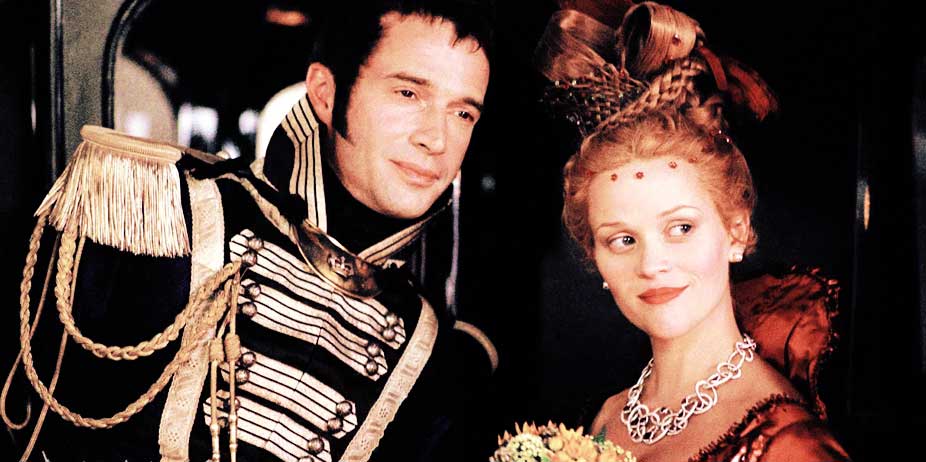
Becky schemes and plans her rise in society, beginning with flirtations with Pitt Crawley (Jr.) who is engaged to a Lady Jane Sheepshanks (Natasha Little, side note: she played Becky Sharp in A&E's Vanity Fair), his rogue soldier brother Rawdon Crawley (James Purefoy), and even the old Sir Pitt Crawley (Bob Hoskins) himself. When Sir Pitt's rich maiden sister Miss Matilda Crawley comes to visit, the household and family scramble to impress their rich relative. The persnickety Miss Crawley takes an instant shine to Becky and soon leaves, taking her back to London; Rawdon comes as well, seeming quite intrigued by the fiery social climber. Becky receives a proposal by a surprise suitor but her answer shocks both her suitor and her relatives. The foxy little Miss Sharp is on the fringes of society, yearning for acceptance. How far will she go to reach the top? Will she ever stop? Whose lives will be affected along the way? You will be amazed at the journey this young "heroine" takes through the throes of English and European society.


There is very little language in this film: I noticed a use or two of the Lord's name in vain, and not much else, but there is some objectionable content: a woman's backside is shown briefly as she leaves the bath, and a husband and wife are shown half dressed in bed in an "after sex" scene that is somewhat intense. They kiss and caress while carrying on a conversation, and the atmosphere is highly sensual. On several occasions married people flirt with characters other than their spouse. A man tries to take advantage of a woman but is stopped; lots of cleavage is shown and an Indian is present that is very sensual. There is a small bit of violence as well:  a few scenes of war show dead bodies strewn about and disastrous aftereffects. A man goes after another man (with good reason) and hits him repeatedly. 


Mira Nair's Vanity Fair was based on the incredibly long classic novel by William Mackepeace Thackeray.  This remake covered all the main points of the book, although it did cut out a few important minor characters and heighten the importance of another. The screenplay was almost as-true-as-can-be to the novel, with minimal differences: the difficulty in telling so much story in so little time was apparent: it seemed to fall a bit flat. A slow moving period piece that is sometimes dramatic, sometimes delightful, sometimes intense, sometimes deliberate, sometimes too sensual, and sometimes ... well, almost off?!  It's hard to describe. While I really enjoyed this film and will buy the DVD when it's out, there were definitely missing elements. It was gorgeous. It was well-acted, and fairly well-written. It was well-costumed and well-filmed. But it failed to touch my heart or emotions deeply: there were moments that moved me, but it lacked the element of reality. Films that touch you make you believe, even if only for a moment, that they are real: that Peter Pan can fly, that Cinderella found her Prince Charming, that fish and toys can talk.  Somehow, even while enjoying these 2 and 1/2 hours of almost-Thackeray, I just had trouble believing these people really lived: I loved and was disappointed in this film at that same time.


Editor's Review:


When William Mackepeace  Thatchery wrote his novel about Becky Sharp so many years ago, he never imagined that a Hollywood starlet would play the role with such charm and devotion. Mia Noir’s adaptation takes less than half the time of Masterpiece Theatre’s version, leaving out huge chunks of the novel and attempting to carry the period piece along on merit alone. It does a fairly good job of it, although as most critics have pointed out, there’s a little something missing. Maybe it’s a bit more deviltry on Becky’s part, for Reese’s portrayal is empathetic where in the novel she was purely scheming.


Little Becky Sharp is a woman without title, status, or wealth. Raised as a servant in a boarding school after the death of her father, she has set her sights on society. The best means of achieving this is through marriage to a respectable man. Summering with her good friend Amelia (Romola Garai), Becky attempts to lure Amelia’s brother into an understanding, but the relationship is diverted through the pious wrangling of Amelia's self-centered fiancée, George Osborne (Jonathan Rhys-Myers). Unwilling to share family ties with a half-French servant girl, he persuades Jos to abandon the cause.


Becky is therefore sent away as a governess and soon becomes a companion to a crotchety old woman with money to spare and relatives constantly scheming at how to get it. Here she is introduced to Rawdon Crawley (James Purefoy), a wealthy playboy who soon wins her heart. When an unexpected proposal comes one morning, she’s forced to reveal the truth: that she’s married Rawdon. His aunt is horrified and flings them from the house, leaving both to poverty. They soon face the challenges of impoverished marriage while expecting their first child, and Becky must charm her way into the heart of society… little realizing that this one flirtation may cost her everything.


My greatest complaint with Vanity Fair is its lack of explanations. One moment Becky is indifferent to Rawdon, the next she’s telling his aunt that they’ve been married in secret. George burns  Amelia’s letters to him in disgust before the eyes of an astonished friend, but refuses his father’s orders to marry well, instead choosing to keep his promise to Amelia. Why? Was it because of sheer rebellion toward his father, or was there a smidgeon of responsibility in his breast after all? Minor characters also drive us to distraction. I wanted to slap Amelia for being such a silly twit when it came to the man who truly loved her. Fortunately all of this is rectified in the end.


These flaws aside, the production is lavish and the acting exquisite. If you’re a fan of these films in general, you’ll enjoy the glimpse into the Napoleonic period and find Reese’s performance worthy of an Oscar nomination. For the most part it’s decent. There are flirtations between married men and women other than their wives, and Becky is either completely oblivious to one older man’s advances or foolishly entertaining them without intending to return his favors, but no adultery is ever carried out. Added for comic relief is one completely unfunny instance when an old woman climbs up out of the tub, revealing brief backside nudity. Becky and her husband kiss in bed, and various amounts of cleavage are present. Language is almost nonexistent and the acts of kindness throughout from some truly noble characters bring up good points for discussion. The ending, while ambiguous, gives audiences the chance for interpretation: is Becky just an adventurer, or are her ambitions higher after all? Altogether it’s slightly flawed in terms of writing, but beautiful nevertheless.


© www.charitysplace.com - all rights reserved.