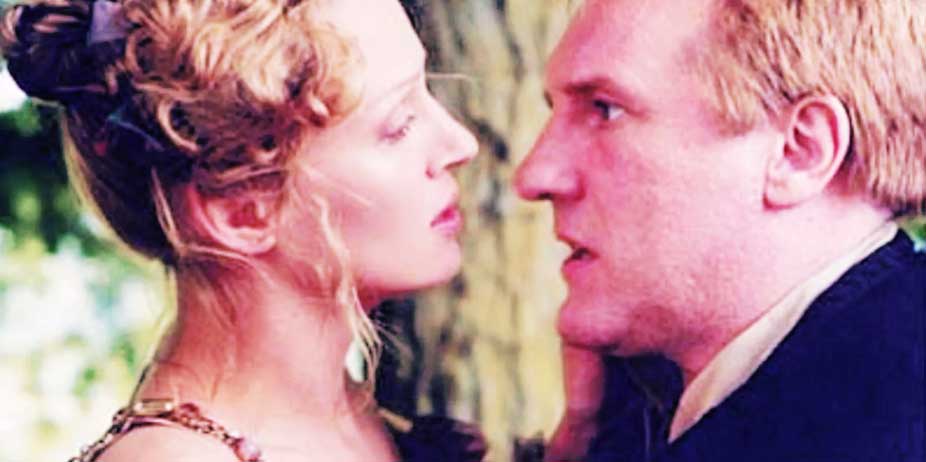
Vatel (2000)
Miramax is known for its lavish, lush adaptations of classic
literature. It specializes in many eras, from Emma to An
Ideal Husband and Shakespeare in Love. One of its
lesser-known foreign films is Vatel, a story based on a
true-to-life event in French history. While gorgeous to look
at, it betrays itself by too much pomp and not enough
feeling. At the height of society in the perpetually dark
seventeen hundreds, France is contemplating a war with
Holland. His Majesty Louis XIV (Julian Sands) is seeking the
proper general to lead his victory, and among those being
contemplated is Prince de Conde (Julian Glover), an outer
limb of the aristocracy and a former war hero who is gravely
in debt to his creditors.
Hoping against hope that he will gain the position, the
Prince invites the royal court to his country estate where
he hopes to buy into the king's favor by giving him an event
to remember. The Prince's master of ceremonies is Vatel (Grard
Depardieu), a man of little means and country roots, but an
impressive sense of artistic valor. The house becomes a
flurry of activity as preparations are made, rooms are
quarreled over, the silver is polished, and hundreds upon
hundreds of baskets of food are purchased on credit. When
the royal court does arrive, among them is the beautiful
Anne de Montauseir (Uma Thurman), one of the queen's ladies
in waiting. Favored by the king's right hand man, whose
overtures she refuses, she finds Vatel a fascinating man,
his talents unique and free from the ceremony and cruelty of
court. He is not like the other men in her life, those who
seek to use her only for their own purposes. Anne walks a
narrow path, for she has caught Louis' eye... but her heart
is steadily growing fond of Vatel, much to the displeasure
of her other admirers.
All is not progressing well in the country. The surfs are
anxious to be paid for the lavish festivities which they
have donated to Vatel's house to impress the king. The
King's brother has taken a dislike to Vatel's sense of
ceremony and his friends are almost uncontrollable. Amidst
the polished silver and sugar flowers is brewing a sinister
thread of trouble, not merely amongst the aristocracy, but
those below kitchens as well. Can Vatel cut off trouble at
its source, or will his house of cards come tumbling down?
Visually, this film is a delight. The costuming and sets are
exquisite, the lavish decorations revealing to a shocked
audience just how frivolous the court of France was in this
period. Some of their festivities would put modern galas to
shame. The food looks utterly delicious, more of a feast for
the eyes than the stomach. We watch in jealousy as the king
and his courtiers are given ornate formations of sugared
flowers and fruits, and platters of food decorated in
peacock feathers.
Typical to the French, passions run wild but the film never
entirely manages to make us care all that much. In delicate
taste, the film alludes to many an impassioned affair...
hints of scandal and impropriety while never entirely giving
it all away or showing us too much. This type of filming is
almost as disconcerting as showing everything; for you know
what's going on just below the surface. Sadly, all of the
main characters are immoral. The film's worst flaw is that
it doesn't have much heart behind it. We grow fond of Vatel
and Anne out of self defense, but the ending is depressing
and the means of getting there as fragile as glass
ornaments. When all is said and done, it's a pretty piece of
wrapping with an empty box as as profit: pretty to look at,
but empty.
Sexual Content:
Sexual blackmail is used on one occasion; implications of
homosexual overtures; implications of adultery; on two
occasions nudity is implied: Anne hurries to return to her
rooms (seen in silhouette), and a boy is tossed into a giant
washing barrel.
Violence:
Men are stabbed, battered, and whipped; blood spatters the
wall and floor, and is seen on aprons and hands. A servant
is accidentally strangled. Vatel is forced to sacrifice his
parrots to save Anne's birds; they are killed and their
hearts wrapped around a gout foot.