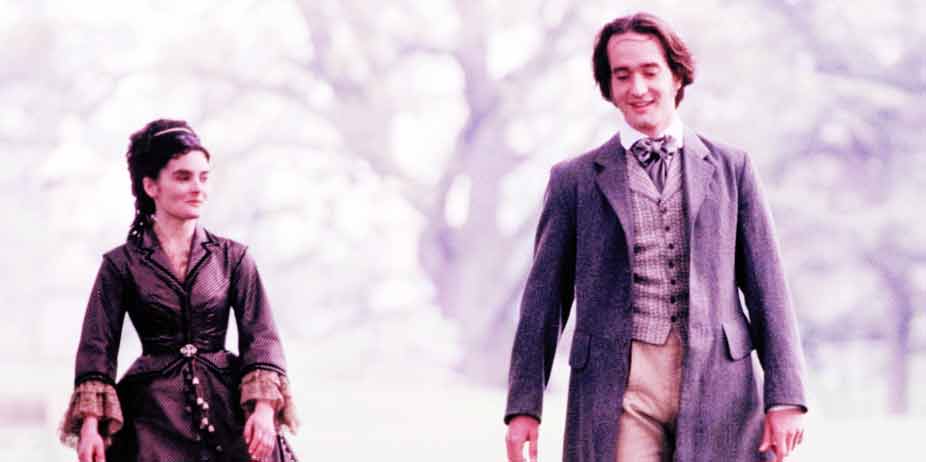
The Way We Live Now (2001)
Anthony Trollope was famous for authoring Victorian satire, but this adaptation manages to fall flat. Between Trollope's over the top villain, the painful moments of failure and embarrassment, and a cast of characters out of which one would be hard-pressed to find one they like, The Way We Live Now is a four-hour period film which takes an exceptionally long time to tell and doesn't have a particularly gratifying conclusion. The storyline initially revolves around several various families in the height of Victorian society. First there are the Melmottes. An extremely wealthy but vulgar family from abroad, Melmotte (David Suchet) has brought his wife and daughter to England in order to become a respectable gentlemen. His poor wife can barely speak a world of English, and his daughter (Shirley Henderson) is a bad-tempered, abused little waif whose only draw in gaining masculine attention is through her immense fortune.
The money has caught the eye of Sir Felix Carbury (Matthew MacFayden), a baronet who has managed to ruin his family financially thanks to his fetish for the gambling tables. His mother, an authoress, is eager for Felix and her daughter Hetta (Paloma Baeza) to both marry well, and encourages him to court Marie Melmotte. The girl is surprisingly receptive, but her father would oppose the match. The man is slowly buying his way into the most influential circles in Europe. In the meantime, Hetta's cousin Roger has asked for her hand... but she is irresistibly drawn to his best friend, Paul Montague (Cillian Murphy), a young entrepreneur who wants to build a railroad through Mexico. He's taken his business proposal to Melmotte, who has tentatively agreed to help finance the venture. But something stands in the way of Paul's affection for lovely Hetta Carbury... namely an American woman he had an affair with several years before.
Mrs. Hurtle (Miranda Otto) is wealthy, beautiful, accomplished... and deadly. Her reputation abroad is that of the woman who shot her husband after he ran out on her. Mrs. Hurtle claims Paul is still engaged to her... and as it's only the woman who can break off the engagement, he's suddenly found himself in a regular Pandora's box just waiting to spring open and ensnare them all in scandal. Marie is madly in love with Felix, who's not prepared to tackle Melmotte and ask for an engagement. He's also secretly fooling around with a pretty little Irish lass in the countryside. All of England has mockingly regarded the Malamutes as vulgar foreigners... but suddenly his stocks in the Mexican Railroad are going for five hundred pounds a share. Melmotte is either standing on the biggest financial gain of the century... or the greatest con of the millennium.
The Way We Live Now is a satire of immense proportions, but even in satire the viewer or reader must identify in some way with the characters. Unfortunately, there's no one to root for aside from the honorable Roger Carbury and a sweet Jewish banker... who both, essentially, get left in the cold at the end. The characters are all immoral in some form or another, ranging from being con men to gamblers and philanderers. The woman fail to gain much respect either. Mrs. Hurtle comes to England for the sole purpose of either seducing Paul back into her life or ruining him for it. Hetta is pushed around doggedly and foolishly falls for a jilt. Felix is a scum ball. His mother is nearly as bad. And then there are the Melmottes.
I've actually seen this film twice, though not on the whole. I originally checked it out because of the cast, but couldn't make it past part two because it lagged so much. I didn't much care for it, even beyond the obvious flaws. It seemed way too long and drawn out, and there was no great stirring redemption of an ending... all the characters got their just dues (well, sort of... this IS satire, remember?) and a few turned out to be more honorable than intimated, but still it lacks something. A moral, perhaps? For a period piece, the costuming is all right, though you can tell they skimped in places. Mrs. Hurtle wears the same two gowns throughout her six-week stay in England. Difficult to believe for a wealthy American businesswoman. Hetta's limited wardrobe is more acceptable, since we know they have money problems. David Suchet is at his element, playing the revolting Mr. Melmotte. He does an exceptional job. The rest of the cast fills in well -- I was actually impressed at Miranda Otto's ability to forge a Southern belle accent. Most of the film is hysterically humorous in an off-the-cuff dry humor, but turns almost painful to watch in the last half when the truth comes out.
Sexual Content:
Marie is always grabbing and kissing Felix, who's carrying on
with a local farm girl. He's seen fastening his pants at one point, and
also rolling around with her in the woods (with a lot of deep breathing
and comments along the way). When the girl finds out he's just been
fooling around and has no intention of ever making it as far as the
chapel door, she runs out on him. He catches up to her in an alley and
in a fury tries to rape her. His halfhearted, clumsy attempts are
quickly stopped when one of her true suitors comes by and knocks his
block off. Paul's past relationship with Mrs. Hurtle is also implied to
have been intimate. She asks him to stay the night. We see him helping
her take off her stockings, but learn later he refused on the basis of
his love for Hetta.
Language:
General profanity and mild abuse of deity.