 Wuthering
Heights (1992)
Wuthering
Heights (1992)
The Brontes have become synonymous with a darker side of English life. Charlotte penned Jane Eyre. Her sister Emily wrote Wuthering Heights, a novel of forbidden love, cruel revenge, and sinister elements of human nature. The film begins on a decidedly dark note with Emily Bronte wandering into an abandoned manor overgrown with tangle woods in a shifting gray fog. She informs the viewer grimly that it is a dark tale and that we should "take care not to smile upon any part of it."
Wuthering Heights lies in darkness, a foreboding presence off the main road as the traveler approaches. Asking for a room for the night, he is refused by the master, a cruel and mysterious figure, but placed in an upper chamber by the maid. "Do not place a candle in the window, sir," she bids him. But curiosity takes over and he does so; shortly thereafter a face appears in the window, a ghostly, haunting face. Long fingernails scratch on the glass, pleading to be let inside out of the storm. He has stumbled on the end for a very old, very cruel story that has haunted the high gray walls of Wuthering Heights since the beginning of time. Hindley and Cathy are the spoiled children of a wealthy landowner on the moors. Their life is unexpectedly altered when their father brings home a ragged orphan from the streets, a lankly child named Heathcliff. Earnshaw seems to favor the adopted child more than his own son, which causes much resentment between the boys, but Cathy is drawn inexplicably to the newcomer's dark, foreboding presence.
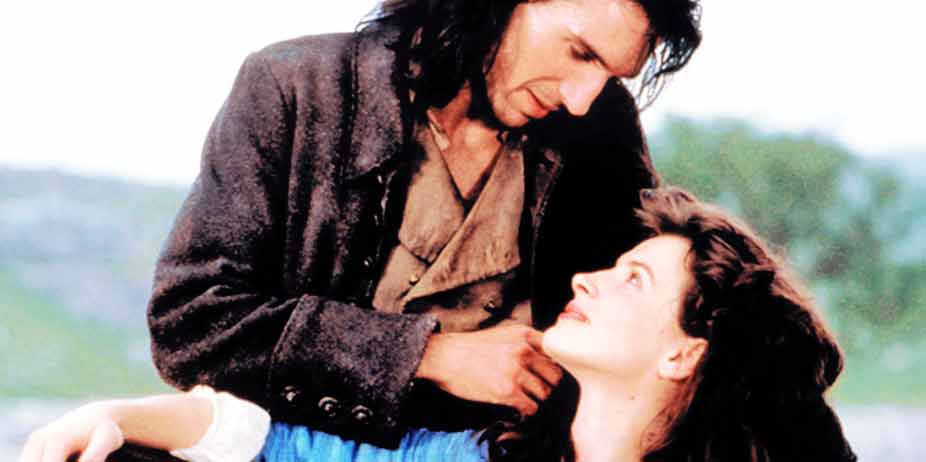
With their father's death, Hindley (Jeremy Northam) casts Heathcliff (Ralph Fiennes) from the house. This, however, does not dissuade Cathy (Juliette Binoche) from her pursuit of her one true love. When a tragic accident befalls her, she is taken to the nearby home of the Lintons, where brother and sister Edgar (Simon Shepherd) and Isabella (Sophie Ward) reside. Her recovery is slow and when at last she returns to Wuthering Heights, she finds her home much altered. Torn between a marriage proposal from Edgar and her love for Heathcliff, when he vanishes into the night from which he came she is somberly wed believing that she will never see him again. Unknowing that her own childish humor at the idea of being in love with two men has driven him off, she mourns her loss and then marries Edgar. The curse of Wuthering Heights will linger, its legacy of death, hatred and evil never fully penetrated. Heathcliff seems to draw on it. When he returns, now a wealthy and prosperous man, he is furious to find Cathy married and takes his revenge by gaining control of the family estate.
He seems to enjoy tormenting her, pursuing her, angering her husband, and wooing poor Isabella. Where will it all end? Only death can rescue Cathy from Heathcliff's powerful grip.... or will it? Not even death might spare her from the curses of this evil man who would leave behind a legacy of betrayal, lies, and evil. This film -- and the book it is based on -- is dark indeed, from its ghostly haunting to the cruel legacy of violence that Heathcliff leaves behind. The one moral lesson that could be learned from these terrible chapters in the Earnshaws' lives is the importance of compassion. Heathcliff only turns upon them when he is rejected, reviled and abused at the hands of Hindley. Only his son can stop this terrible tradition; we are left with a bittersweet ending. The costuming is gorgeous, the English countryside haunting, the soundtrack unforgettable. The acting is brilliant; Ralph Fiennes gives the performance of his lifetime.
Sexual Content:
Heathcliff attempts to seduce Cathy away from
her husband; the two share several adulterous kisses, although the relationship
thankfully never seems to progress further.
Language:
There is some mild
language.
Violence:
There's a moderate amount of violence and
gothic horror-style moments, one of which includes the digging up of a grave for
a last look at the corpse. He abuses her daughter Catherine, violently forcing
her to marry his dying son; he treats Hindley's young child heartlessly and marries
and abuses Isabella.
Other:
Ghosts
haunt the manor, unsatisfied with their deaths.