 Wuthering
Heights (1998)
Wuthering
Heights (1998)
Many years ago, I ran across my first copy of Wuthering Heights, and to this day I still cannot understand the lure of audiences through numerous generations to the tormented darkness of its leading anti-hero. Emily Bronte, much like her sisters, led something of an unhappy life, and it is misery that comes through most prominently in her work, even though in the end there is a glimmer of hope.
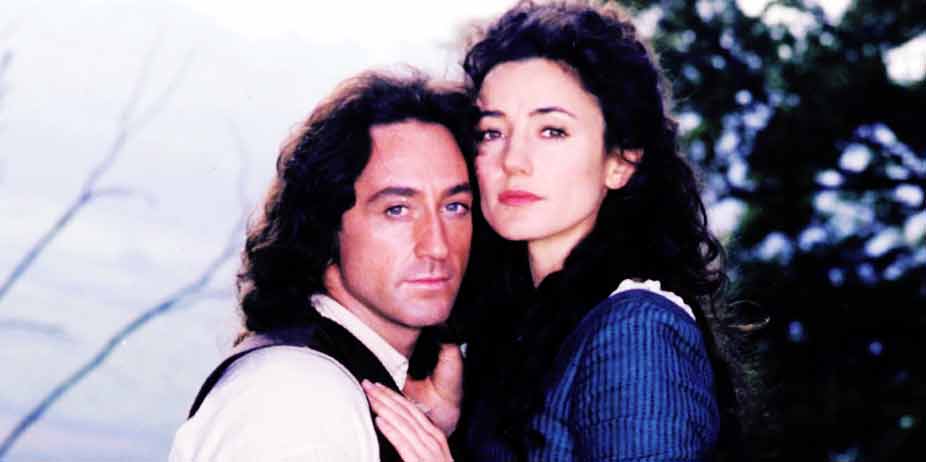
The new tenant of Wuthering Heights has come stumbling to the main house in the midst of an impending storm to pay heed to his new landowner, the wild and terrifying Heathcliff (Robert Cavanah). Forced to remain there overnight or become lost in the rain, he is frightened nearly to death by a ghostly child pawing at the windowpane. This event torments those in the house and forces Heathcliff to remember his introduction to the Heights, beneath the arm of a generous benefactor determined to bring up the abandoned gypsy child among his own children. Adored by Cathy and loathed by her cruel brother Hindley, the temperamental Heathcliff grows to adulthood in a tempestuous home.
After the death of his adoptive father, Hindley (Ian Shaw) banishes Heathcliff to the stables, only the spirited Cathy (Orla Brady) feels the injustice of this punishment. Her love for the young man who has so captured her heart is further tested when she falls for the charms of their nearest neighbor, Edgar Linton (Crispin Bonham-Carter). His wealth and place in society makes her resent her low beginnings, and her efforts to stand up for Heathcliff are undermined through a terrible misunderstanding that drives him from the house. Five years later, having raised himself from poverty to a position of power and authority, Heathcliff returns to Wuthering Heights to seek revenge upon all who have slighted him, for generations to come, forever tormenting his soul with the ghost of his lost lover.
If you have read the novel and know what you're in for, this is not a bad adaptation to go with. It doesn't have an enormous amount of faults by way of content, since most of the cruelty is implied rather than graphically depicted, but there are some tremendous instances of thematic elements. As far as adaptations of this bleak story go, this is one of the better ones I have seen. It manages to capture most of the story, unlike others that conclude prematurely without exploring the fates of their children. Indeed, the only redeeming virtue in the tale comes in the form of the gentle, sweet romance between Catherine (Sarah Smart) and mild-mannered Hareton (Matthew Macfadyen). It does not attempt to make Heathcliff out to be heroic, for his deeds are shown in all their dark intention. He is mean to animals, is not above slapping the women in his life around when it suits him, and drives Hindley to insanity through abusive cruelty. It's one of the most harsh depictions of true evil that I have ever seen, for he acts out of an anguish-driven desire for vengeance. In that sense, there is not much redeeming value save to point out how such vile passions can destroy lives.
Sexual Content:
After stealing a woman away from Linton House
in the dead of night, Healthcliff tosses her onto a bed and it's implied they
have sex -- although whether or not it was fully consensual is unclear.
Language:
A handful of scattered profanities pepper the
script.
Violence:
Heathcliff describes how he starved young
birds to death in a rage when Cathy left him for a time, and keeps their
skulls in a box. He hangs a dog upside-down just for the fun of it. He
digs up a woman's grave and embraces the corpse. Several times, he
causes bodily harm to Catherine by throwing her around or slapping her.
He does the same with his wife, Isabella (Flora Montgomery).
Other:
There is an ambiguous spiritual theme running throughout. Heathcliff
sees the ghost of Cathy numerous times -- several instances as a child,
and again as an adult. Eventually, he joins her in death and they roam
the moors together in the afterlife.